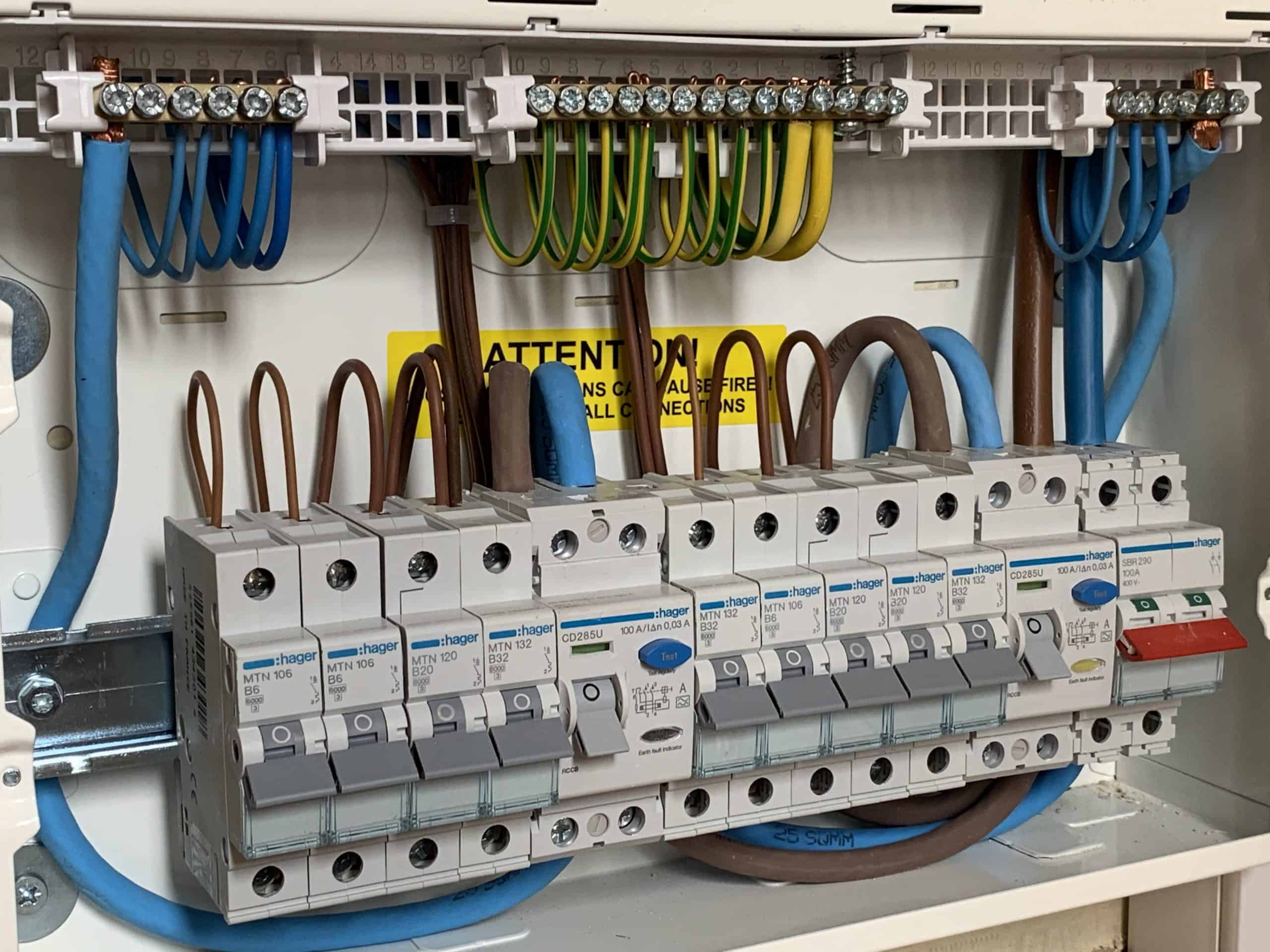
RCDs trip on earth faults and shock risk. This guide explains the most common causes of RCD tripping in London homes and what you should do about it.
What Is an RCD and How Does It Work?
An RCD — residual current device — is a safety switch installed in your consumer unit that monitors the flow of electricity through the live and neutral conductors on the circuits it protects. Under normal conditions, the current flowing out through the live wire returns through the neutral wire, and the two values are equal. When they are not equal, it means current is leaking somewhere — through a damaged appliance, faulty wiring, or a person receiving a shock. The RCD detects this imbalance and trips the circuit within 30 milliseconds when the residual current exceeds 30 milliamps, which is the threshold at which electric shock becomes potentially fatal.
Modern consumer units in London properties typically contain one or two RCDs that protect groups of circuits, or individual RCBOs (residual current breakers with overcurrent protection) on each circuit. If your RCD keeps tripping, the fault is on one of the circuits it protects.
The Most Common Cause: Damaged Garden Cable
In London properties, the single most common cause of a nuisance RCD trip is a damaged cable to an outdoor socket or garden appliance. Garden cables are vulnerable to damage from spades, forks, and lawnmowers, and the outer sheath of a buried or surface-run cable degrades over time when exposed to moisture and UV light. A cable that has been nicked by a spade will develop a partial earth fault, particularly when it is wet, which triggers the RCD. If the RCD trips most often when garden appliances are in use, start by unplugging everything in the garden and testing whether the circuit holds.
Faulty White Goods
Washing machines, dishwashers, and tumble dryers develop earth faults as their internal wiring and motor windings age. A faulty heating element in a washing machine or dishwasher is a particularly common cause of RCD trips in London flats and houses where white goods are five or more years old. To test whether a white good is causing the trip, unplug the suspected appliance before resetting the RCD. If the RCD holds, the appliance is the likely source of the fault.
Shower Cable Faults in Older London Flats
Electric showers draw high current and generate significant heat at the cable connections. In older London flats — particularly those converted from Victorian terraces where the shower circuit was added retrospectively — the shower cable may run through damp wall cavities or roof spaces. Over time, moisture ingress or heat cycling degrades the cable insulation, creating an earth fault. If the RCD trips when the shower is switched on or while it is running, the shower circuit requires investigation by a registered electrician.
Faulty Sockets in Kitchens and Bathrooms
Sockets in kitchen and bathroom zones are at greater risk of moisture ingress. A socket that has had water splashed onto it, or one where the back box has filled with condensation, can develop an intermittent earth fault that trips the RCD. The fault may only appear under certain conditions — for example, after the kitchen has been steamed by cooking or after the bathroom has been used as a shower room for an extended period.
How to Identify Which Circuit Is at Fault
If your consumer unit has a split-load arrangement with two RCDs — one protecting upstairs circuits and one protecting downstairs circuits — the first step is to identify which RCD has tripped. This tells you which group of circuits the fault is on. Once you know which RCD has tripped, switch off all the individual circuit breakers under that RCD, reset the RCD, and then switch the individual circuit breakers back on one at a time. When the RCD trips again as you switch on a particular circuit breaker, you have identified the faulty circuit. Unplug all appliances on that circuit and repeat the test to distinguish between a faulty appliance and a wiring fault.
What Not to Do
Do not keep resetting the RCD without investigating the cause. An RCD that trips repeatedly is detecting a real fault. Repeated resetting without investigation is dangerous because it exposes you and anyone in the property to the risk the RCD is designed to protect against. Do not tape the RCD in the on position or bridge the contacts — this is extremely dangerous and is illegal under the Electricity at Work Regulations.
When to Call a London Electrician
You should call a registered electrician if the RCD trips without any obvious appliance cause, if it trips immediately every time it is reset, if you can smell burning near the consumer unit or any socket, or if isolating appliances one by one does not identify the source of the fault. An NICEIC-registered electrician can use insulation resistance testing equipment to identify the exact location of the earth fault on the circuit without the need for guesswork. Prestige Engineers provides same-day RCD fault diagnosis across all London boroughs.