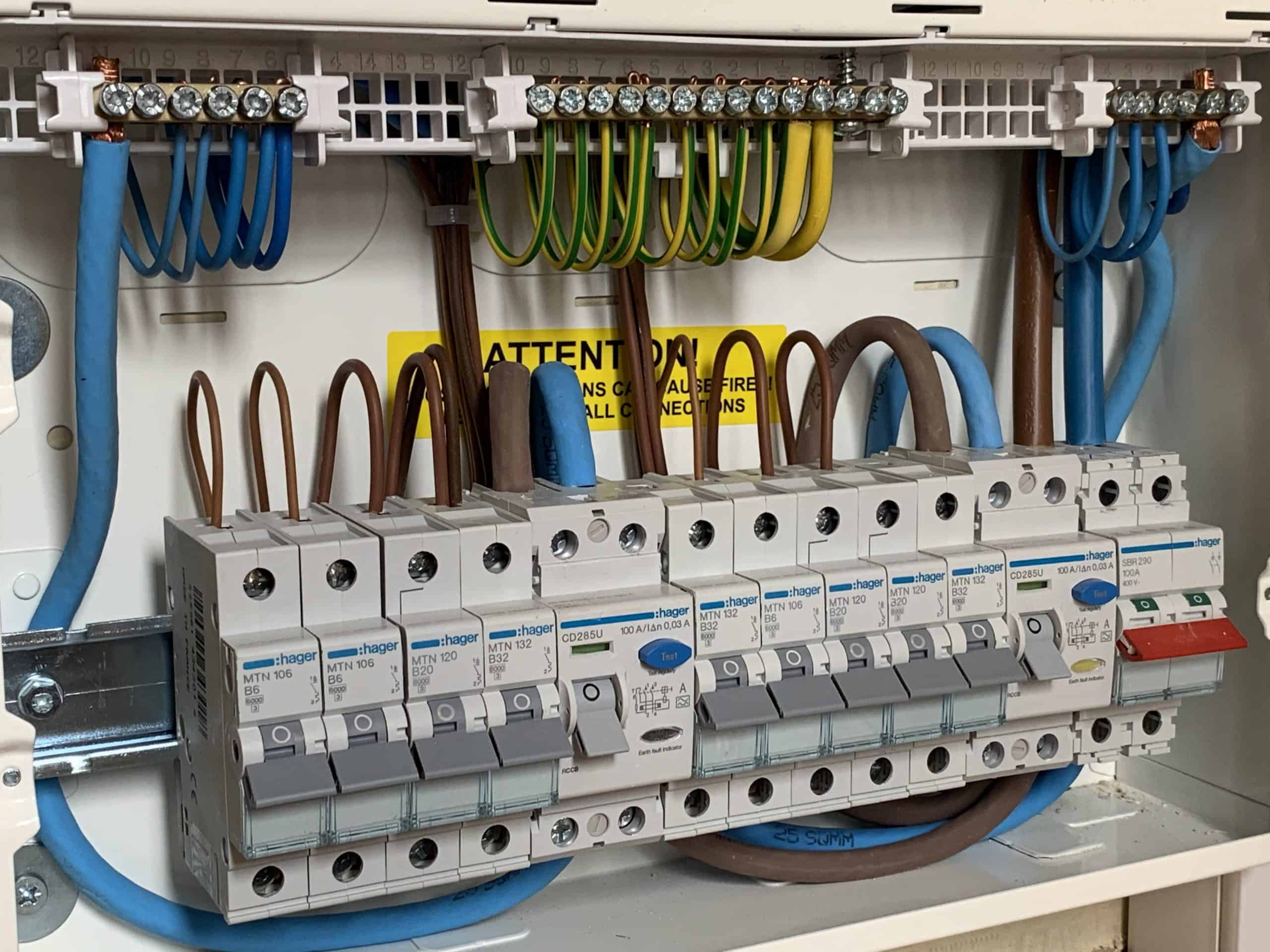
Electrical emergencies are among the most serious household crises — and also among the most misdiagnosed. Knowing the difference between a tripped circuit breaker that you can safely reset and a fault that requires an immediate electrician call-out could save your home. This guide covers what constitutes an electrical emergency, what you can safely check yourself, and what to expect when an electrician attends.
What Counts as an Electrical Emergency
Not every electrical problem is an emergency — but some absolutely are. Being able to distinguish between them determines whether you call an emergency electrician immediately or wait for a standard appointment.
Total Power Loss
Complete loss of electricity throughout the property — no lights, no sockets, nothing working — requires investigation. First, check whether the problem is external: look out of the window at neighbouring properties. If their lights are on and yours are not, the fault is within your property. If the entire street or block appears dark, it is likely a distribution network failure — contact your distribution network operator (UK Power Networks serves most of London), not an electrician. Report the outage on the UK Power Networks number (105, available 24 hours).
If the problem is internal — neighbours have power and you do not — check the consumer unit (fuse board). A total loss is often caused by the main RCD (residual current device) tripping. Locating and resetting it may restore power. If it trips again immediately, there is an underlying fault that requires an electrician.
Sparking or Arcing at Sockets or Switches
A spark when a plug is inserted into a socket, or sparking visible inside a socket or light switch, is a serious fault. It indicates either a loose connection in the socket or switch that is arcing under load, or a damaged appliance causing a fault current. Do not use the socket. Turn off the circuit at the consumer unit if you can identify which circuit it is on. Call an electrician to investigate — arcing connections cause fires.
Burning Smell from Socket, Switch, or Consumer Unit
A burning or scorching smell from any electrical fitting — particularly from a socket, a consumer unit, or from a light fitting — is an emergency. Turn off the relevant circuit at the consumer unit or, if you cannot isolate it, turn off the main switch. Call an emergency electrician. Do not leave the property unattended if you smell burning from electrics — the risk of fire is real and immediate.
Tripped RCD That Will Not Reset
The RCDs (residual current devices) in your consumer unit protect against electric shocks and earth faults. A tripped RCD that resets successfully once, then trips again, indicates an ongoing fault on that circuit. Systematically unplug all appliances on the affected circuit and try resetting again — if it holds, one of the appliances has a fault. If it trips even with all appliances unplugged, there is a wiring fault on the circuit that requires an electrician.
Flooding Near Electrical Installations
If there is water ingress — from a burst pipe, a roof leak, or flooding — near any electrical installation, treat the electricity in that area as immediately unsafe. Turn off the relevant circuits at the consumer unit. Do not touch any electrical fitting in a wet or damp area. Do not enter a flooded room if the flood water might be in contact with electrical fittings. Call an electrician before restoring power to affected circuits, even after the water has been removed — water inside electrical fittings requires inspection before they can be used safely.
Electric Shock
If anyone receives an electric shock from an appliance or fitting — even a minor one — that is an emergency. For a minor shock, turn off the circuit and do not use the fitting again until it has been inspected by an electrician. For a significant shock, call 999 first, then turn off the electricity supply if it is safe to do so. An electric shock indicates a dangerous fault in the appliance or wiring — it must be investigated before the circuit is used again.
What to Check Yourself First
Several electrical issues have simple explanations that do not require an emergency call-out:
- Which circuit has tripped: If some lights work and others do not, or some sockets work and others do not, go to the consumer unit and look for the circuit breaker or MCB (miniature circuit breaker) that has tripped — it will be in the off or middle position. Switch it fully off, then fully on again. If it stays on, the issue was likely a temporary overload.
- Check whether it is a power cut: The UK Power Networks 105 number is free and available 24 hours. If it is a network fault, they will be investigating — no need for a private electrician.
- Identify the source of a tripped RCD: Unplug all appliances on the affected circuit systematically. Kitchen appliances — toasters, kettles, microwaves — are frequent causes of RCD trips when they develop faults. A faulty appliance causing an RCD trip is the appliance's problem, not the wiring's.
When NOT to DIY
The following electrical work must never be attempted by an unqualified person, regardless of how confident they feel:
- Any work inside the consumer unit — replacing MCBs, RCDs, adding circuits, or investigating faults inside the board
- Any work on fixed wiring — adding a socket, extending a circuit, chasing a new cable into a wall
- Any work behind a wall, under a floor, or in a ceiling void where cables run
- Any work on the main supply cables from the meter to the consumer unit — this section of wiring is the responsibility of the distribution network operator, not the homeowner, and must only be touched by their authorised engineers
In England, certain types of electrical work in dwellings are "notifiable" under Building Regulations Part P — they must be carried out by a registered competent person or notified to the local building control authority. Notifiable work includes: installation of a new circuit, consumer unit replacement, installation in a bathroom or outdoors. Non-notifiable work includes: like-for-like replacement of a socket, switch, or light fitting that is not in a bathroom or kitchen, and repair of existing circuits.
Finding a Qualified Electrician in London
For any notifiable electrical work, use a Part P registered competent person. Registration schemes include NICEIC (National Inspection Council for Electrical Installation Contracting), NAPIT, ELECSA, and others. You can verify any electrician's registration on the government's competent person register at competentpersonscheme.co.uk.
A Part P registered electrician can self-certify their own notifiable work — they do not need building control to inspect it. An unregistered person carrying out notifiable work must notify building control before starting, and the work will be inspected. Unregistered work is technically unlawful if it is notifiable and has not been authorised through building control.
What to Tell the Electrician When You Call
When calling an emergency electrician, describe the fault precisely to help them diagnose it before attending and arrive with appropriate equipment:
- Which part of the property is affected (whole property, single room, specific circuit)
- What symptoms you observe (no power, sparking, burning smell, tripped breaker)
- What you have already checked (whether it is a power cut, which circuit is tripped, whether unplugging appliances affects the fault)
- Any recent events that preceded the fault (was work recently done on the electrics, has there been a recent flood or storm)
- The age of the consumer unit if known — older boards with rewirable fuses or early RCDs are more likely to have faults than modern dual-RCD boards
What the Electrician Does
An emergency electrician attending a fault will follow a systematic process:
- Identify and isolate: Confirm which circuit is affected and isolate it at the consumer unit before working on it.
- Diagnose: Use a multimeter, loop impedance tester, or insulation resistance tester to identify the nature and location of the fault. Is it the circuit wiring, a fitting, or an appliance?
- Repair or replace: Fix the identified fault — replace a failed socket, repair a loose connection, replace a failed MCB or RCD.
- Test: After repair, carry out the relevant electrical test to confirm the circuit is safe — polarity, earth continuity, insulation resistance, loop impedance.
- Issue documentation: For any notifiable work, the electrician must issue a Building Regulations Compliance Certificate and an Electrical Installation Certificate or Minor Electrical Installation Works Certificate, depending on the scope of work.
Cost of Emergency Electrical Call-Outs in London
Emergency electrician call-outs in London typically cost £150–£350 for the call-out itself, covering attendance, diagnosis, and a standard repair. More complex faults requiring extended investigation, parts replacement, or circuit work cost more. Confirm the call-out rate and the hourly rate after the first hour before work begins. Reputable electricians will provide a clear estimate of the total cost after initial diagnosis before proceeding with significant work.
Frequently asked questions
What counts as an electrical emergency in a London home?
Electrical emergencies requiring immediate call-out include: sparking or arcing at sockets or switches; a burning smell from any electrical fitting; an RCD that trips repeatedly even after all appliances are unplugged (indicating a wiring fault); flooding near any electrical installation; total power loss that is not a network power cut; and any electric shock. Total power loss should first be checked against your consumer unit and confirmed as not a network failure (call 105 free) before calling an emergency electrician.
Can I reset a tripped circuit breaker myself in London?
Yes — if an MCB (miniature circuit breaker) or RCD in your consumer unit has tripped, you can try to reset it by switching it fully off and then fully on again. If it stays on, the issue was likely a temporary overload. If it trips again immediately, there is an underlying fault. Before calling an electrician, systematically unplug all appliances on the affected circuit and retry — a faulty appliance is often the cause. If the breaker trips even with all appliances disconnected, a wiring fault is present and requires a qualified electrician.
Do I need a Part P registered electrician for emergency repairs in London?
For any notifiable electrical work — which includes consumer unit work, new circuit installation, and any electrical work in a bathroom — yes, the work must be done by a Part P registered competent person (NICEIC, NAPIT, ELECSA, or similar scheme). Like-for-like replacement of a socket or switch outside a bathroom is non-notifiable and can be done by any competent person. For emergency fault diagnosis and repair, always use a registered electrician regardless of the scope — emergencies are not the time to compromise on qualification.
How much does an emergency electrician cost in London?
Emergency electrician call-out costs in London typically range from £150–£350, covering attendance, initial diagnosis, and a standard repair. Complex faults or extended investigation cost more at an hourly rate after the initial call-out charge. Always confirm the call-out rate and after-hours premium (emergency rates are higher than standard rates, typically 1.5–2x) before the electrician attends, and ask for an estimate of total cost after initial diagnosis before authorising significant work.