Purpose-built London flats present specific rewiring challenges because of concrete floors and structural walls. This guide explains how cables are run, what to expect during the work, and why costs are higher than for a house.
Why London Purpose-Built Flats Are Harder to Rewire
The majority of purpose-built flats in London were constructed between the 1930s and the 1980s using reinforced concrete frame construction with concrete floor slabs. Unlike Victorian and Edwardian terraced houses, where timber joist floors can be accessed by lifting floorboards to run new cables in the joist void, the concrete floors in purpose-built flats offer no such access route. The implications for a rewiring job are significant: every cable run that cannot be routed through the ceiling void or along the wall perimeter must either be surface-run in trunking, chased into the floor screed, or threaded through any existing conduit that may have been installed when the block was built.
In addition to the floor challenge, purpose-built flats typically have concrete block internal walls rather than timber stud partitions. Running cables through concrete block walls requires chasing — cutting a channel in the wall face with an angle grinder — which is dusty, disruptive, and adds to the making-good cost after first fix. In timber stud partitions, cables can be threaded through the void between the studs from above or below, which is less disruptive.
Cable Routing Options in London Flats
Ceiling void routing. Many purpose-built London flats have a suspended ceiling or a ceiling void between the concrete floor slab above and the plasterboard ceiling below. Where this void exists, it provides a practical cable route for lighting circuits and for the first part of ring final circuits that can then drop down the wall. Whether a ceiling void exists, and how accessible it is, is one of the first things a NICEIC electrician will establish during a survey of a London flat for rewire.
Surface trunking (dado rail trunking). Where no ceiling void exists and floor chasing is not practical, cables can be surface-run in plastic or metal trunking fixed to the wall. Dado trunking at approximately 1 metre height provides a skirting-level and desk-height cable route that can accommodate socket outlets in a neat, professional finish. Surface trunking is particularly common in converted commercial buildings and in older purpose-built blocks where the floor construction prevents concealed wiring. It adds to the material cost but avoids the significant disruption of floor chasing.
Floor screed chasing. Where a thick screed layer exists above the concrete slab, cables can be chased into the screed before a new screed topping is applied. This approach requires the existing floor finish to be removed, the screed chased, cables run and protected, and a new screed laid and allowed to cure before the floor finish is replaced. It is the most expensive approach and is only practical when the floor is being replaced as part of a wider renovation. It produces a completely concealed wiring installation but involves 2 to 3 weeks of additional programme time for the screed to cure.
Existing conduit. Some purpose-built blocks built after approximately 1960 were wired using metal conduit systems. In these buildings, the original cable runs are within conduit that may still be intact and usable. The old cables are pulled out and new cables drawn through the existing conduit — avoiding both floor chasing and surface trunking. The viability of this approach depends on the condition of the conduit and whether the original installation was designed with rewiring in mind.
Consumer Unit Location in a London Flat
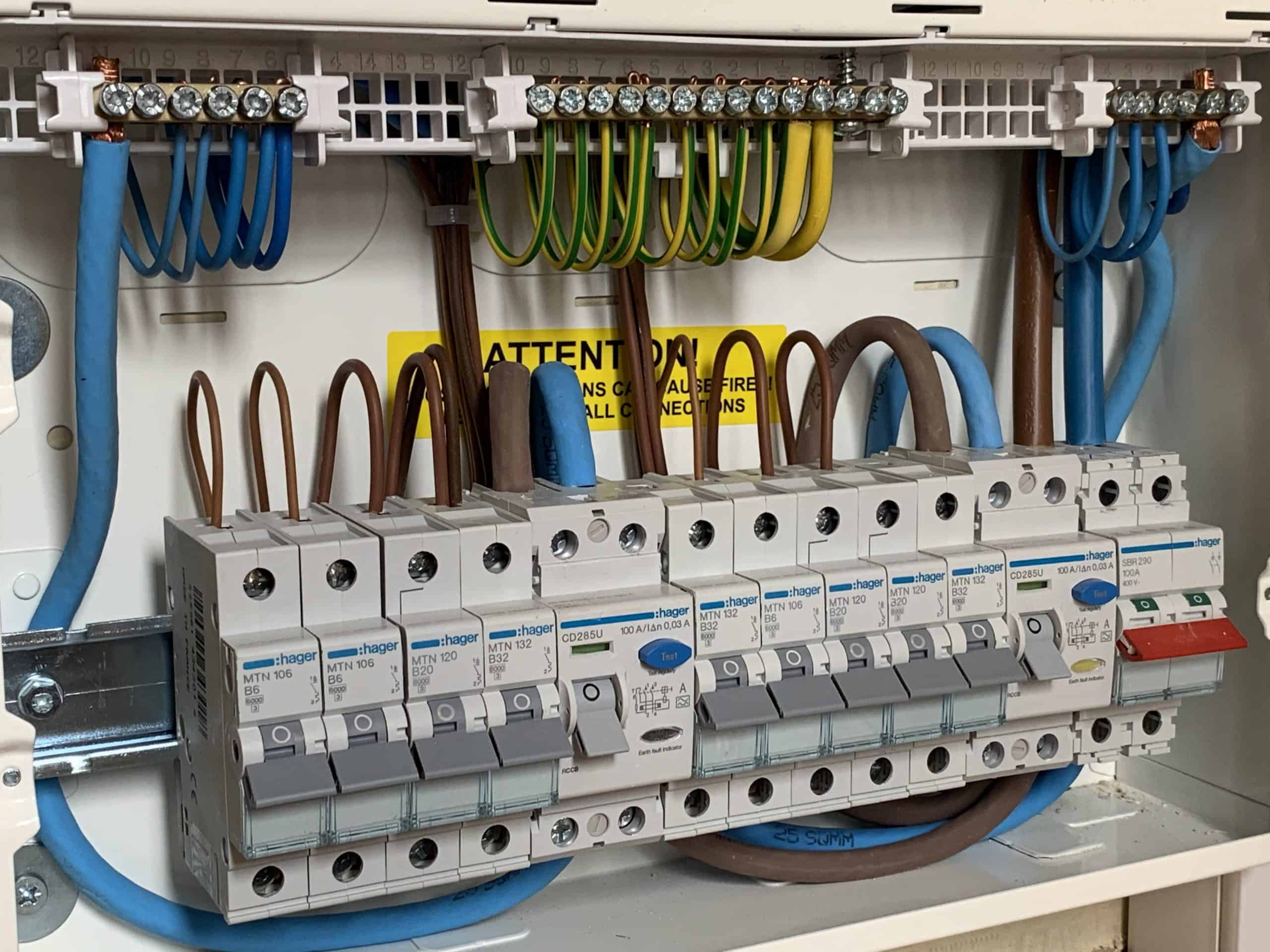
In a purpose-built flat, the consumer unit (fuseboard) is typically located in the hallway near the front door, fed from the landlord supply intake on the common parts of the building. The existing location is almost always reused for the new consumer unit, as moving it would require a new supply cable from the intake. The new consumer unit is a metal-clad 18-way RCBO board, replacing whatever single-RCD or rewirable fuse board was previously installed.
Cost of Rewiring a London Purpose-Built Flat
The concrete floor challenge and the need for surface trunking or screed chasing makes rewiring a purpose-built London flat more expensive than an equivalent-size Victorian terrace. As a guide, a 2-bedroom purpose-built flat in London requiring surface trunking in living areas costs £3,500 to £5,500, compared to £3,000 to £4,500 for a 2-bedroom Victorian flat with accessible timber floors. The cost also depends heavily on whether the work is being done in an empty flat during a refurbishment or in an occupied flat where phased working and careful protection of furnishings adds to the programme.
Prestige Engineers provides free surveys and fixed-price rewire quotes for purpose-built flats across all London boroughs. We advise on the cable routing approach that suits the flat construction and the homeowner budget before any commitment is made.