Electrical Safety in Older London Properties: Rubber Cables, Old Fuseboards, and What to Check
Many London Victorian and Edwardian properties still have electrical installations from the 1960s and 1970s. This guide explains the risks and what to prioritise.
The Electrical Safety Challenge in London Older Properties
London has an extraordinary concentration of older housing stock. A large proportion of the city was built between 1880 and 1939, and much of the electrical installation work carried out in these properties during the 1950s, 1960s, and 1970s has never been fully updated. It is not unusual for a CCTV drain survey or a boiler replacement visit in a Victorian terrace in Hackney, Battersea, or Lewisham to reveal an electrical installation that is 40 to 60 years old. Understanding what the risks are and knowing which issues to prioritise is essential for anyone who owns or manages an older London property.
Rubber-Insulated Cables: TRS and VIR
The most significant electrical safety issue in older London properties is the presence of rubber-insulated cable. Two types are commonly encountered.
TRS (Tough Rubber Sheath) cable was the standard domestic wiring cable in the UK from the 1940s through to the late 1960s. It has a braided cotton outer covering over a rubber outer sheath, with rubber-insulated conductors inside. Over time — and particularly in properties that have been warm or subject to any dampness — the rubber insulation becomes brittle and cracks. The outer sheath develops fissures and the insulation on the individual conductors crumbles when touched.
VIR (Vulcanised India Rubber) cable is older still, found in properties that were wired before the Second World War and have never been rewired. VIR cable has a fabric-wrapped outer layer over rubber-insulated conductors and in many cases the rubber has completely degraded, leaving bare conductors in contact with the fabric wrapping. This is immediately dangerous and should be treated as such.
The critical risk point for rubber-insulated cables is disturbance. A rubber cable that has been sitting undisturbed in a wall or ceiling void for 60 years may appear intact from the outside. The moment a socket is replaced, a new ceiling light is fitted, or a cable is routed through the same void, the brittle rubber insulation cracks and breaks, exposing live conductors. This creates a risk of shock and fire that may not be immediately apparent but can materialise weeks or months after the disturbance.
Lead-Sheathed Cables
In some pre-war London properties, particularly those that were electrified in the 1920s and 1930s, lead-sheathed cable is present. This cable has a lead outer sheath over rubber-insulated conductors. Lead-sheathed cable should be treated as immediately dangerous on discovery and is grounds for a C1 observation on an EICR. Any electrician working in a property with lead-sheathed cables should advise immediate replacement before undertaking any other electrical work.
Old Rewirable Fuseboards
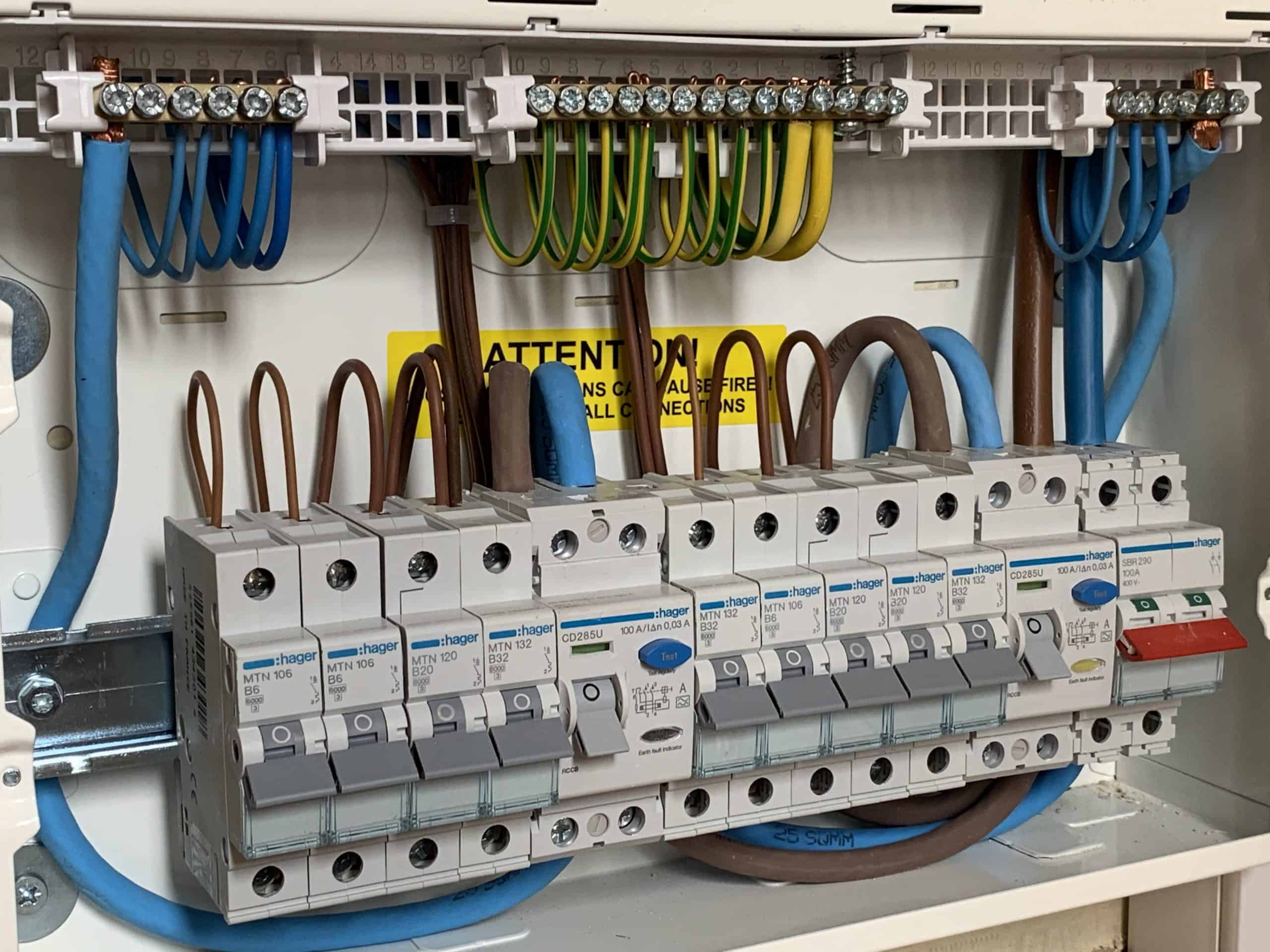
Many older London properties still have a rewirable fuseboard — also called an old-style consumer unit or fuse box — in place of a modern consumer unit with MCBs and RCDs. A rewirable fuseboard has several significant safety shortcomings compared to a modern installation.
- No MCB protection: Rewirable fuses do not trip at a consistent current rating. The fuse wire can be replaced with an incorrect rating — intentionally or accidentally — which removes the overcurrent protection the fuse is intended to provide.
- No RCD protection: A rewirable fuseboard provides no residual current protection. If an earth fault develops on any circuit, the fuseboard provides no protection against shock or fire from sustained earth leakage current.
- No individual circuit isolation: Switching off a circuit in a rewirable fuseboard requires physically removing the fuse carrier, which is less safe and less convenient than switching off an MCB.
Replacing a rewirable fuseboard with a modern dual RCD or RCBO consumer unit is the single most impactful safety improvement that can be made to an older London property. It provides MCB overcurrent protection, RCD earth fault protection, and proper circuit isolation at a cost of £600 to £1,200 depending on the number of circuits and condition of the existing installation.
What an EICR Reveals in Older London Properties
An Electrical Installation Condition Report carried out on an older London property frequently produces C1 and C2 observations. Common findings include: rubber-insulated cables on circuits that have been partially updated (mixed-generation wiring); absence of earthing or bonding at gas and water service entry points (required under current regulations but absent in pre-1966 installations); absence of RCD protection on circuits serving bathrooms, kitchens, or outdoor sockets; single-pole switching on lighting circuits (where the switch disconnects only the live and not the neutral, leaving the neutral energised at the light fitting).
What to Prioritise in an Older London Property
- Consumer unit upgrade: If the property has a rewirable fuseboard, this is the first priority. A modern consumer unit with RCBO protection on each circuit provides comprehensive protection and is the foundation for any subsequent electrical work.
- RCD protection: If the property already has a consumer unit but it lacks RCD protection, adding an RCD or upgrading to RCBOs per circuit provides the earth fault protection that older consumer units lack.
- Replacement of rubber-insulated cables: Where TRS or VIR cables are identified on an EICR, replacement should be carried out circuit by circuit, prioritising circuits that serve bathrooms, kitchens, and any circuit where the cable has been disturbed.
- Full rewire: Where the majority of the installation is rubber-insulated cable, a full rewire is typically more cost-effective in the long run than piecemeal circuit replacement. A full rewire of a typical London terraced house costs £3,000 to £7,000 and provides a new installation with a design life of 30 to 40 years.
Prestige Engineers carries out EICRs and full rewires across all London boroughs. All our electricians are NICEIC registered and experienced in working with older London properties. Contact us to arrange an EICR and get a clear picture of the condition of your installation.