A complete guide to full house rewire costs in London for 2025 and 2026. What affects the price, how long it takes, and what certificate you receive. Based on current London market rates.
What a Full House Rewire Involves
A full house rewire is one of the most significant electrical jobs that can be carried out on a property. The work involves removing all existing wiring — from the consumer unit through every cable run to every socket, switch, light fitting, and fixed appliance connection in the property — and replacing it entirely with new PVC-insulated cable to current BS 7671 wiring regulations. The result is a property with a completely new electrical installation, issued with an Electrical Installation Certificate and formally notified to the local authority under Part P of the Building Regulations.
A full rewire is not the same as adding circuits, upgrading the consumer unit, or replacing individual accessories. It is the complete removal of every cable in the property and its replacement from scratch. It is one of the most disruptive jobs a property can undergo, and it is usually carried out either when the existing wiring has deteriorated to a dangerous state or during a full renovation when the property is stripped back to the structure.
Full Rewire Costs in London: Current Market Rates
Rewire costs in London are higher than the UK average because of higher labour rates, London congestion zone and parking costs, and the complexity of London property types. The following ranges are current for NICEIC-registered electricians in London for 2025 and 2026.
- 1-bedroom flat (30 to 50 square metres): £2,500 to £3,500 — typically 3 to 4 days
- 2-bedroom flat (50 to 75 square metres): £3,000 to £4,500 — typically 4 to 5 days
- 2-bedroom terraced house: £3,500 to £5,000 — typically 5 to 6 days
- 3-bedroom terraced or semi-detached house: £4,500 to £7,000 — typically 6 to 8 days
- 4-bedroom detached house: £7,000 to £12,000 — typically 8 to 12 days
- 5 or more bedrooms: quoted individually based on floor area, number of circuits, and access conditions
These prices include labour, all cable materials, a new 18-way RCBO consumer unit, back boxes, and the Electrical Installation Certificate with Part P notification. They do not include the cost of redecorating after first fix — replastering chased walls and repainting is a separate cost that must be allowed for.
What Drives Cost Variation
The factors that cause the most variation in rewire quotes for London properties are floor type, number of circuits, and access conditions.
Floor type. Timber joist floors in Victorian terraced houses can be lifted board by board to run cables in the joist void, which is relatively quick and causes limited damage if the floorboards are in good condition. Solid concrete floors in purpose-built flats cannot be lifted. Cables must either be surface run in conduit or trunking, chased into the screed (a messy, dusty process), or routed via the ceiling void if one exists. Solid floors add substantially to the labour time and the decoration cost.
Number of circuits. A modern installation for a 3-bedroom house typically requires 8 to 12 circuits — ring final circuits for each floor, a dedicated circuit for the cooker, one for the shower, one for the boiler, lighting circuits, and an outdoor circuit. More circuits mean more cable runs, more consumer unit ways, and more testing time.
Access conditions. A property that is fully stripped back during renovation — with floorboards lifted, ceilings out, and wall plaster removed — is significantly easier and faster to rewire than an occupied property where every floor board must be carefully lifted and replaced and walls must be chased and made good. Rewiring during renovation can reduce the overall labour cost by 20 to 30 percent compared to rewiring an occupied property.
The New Consumer Unit
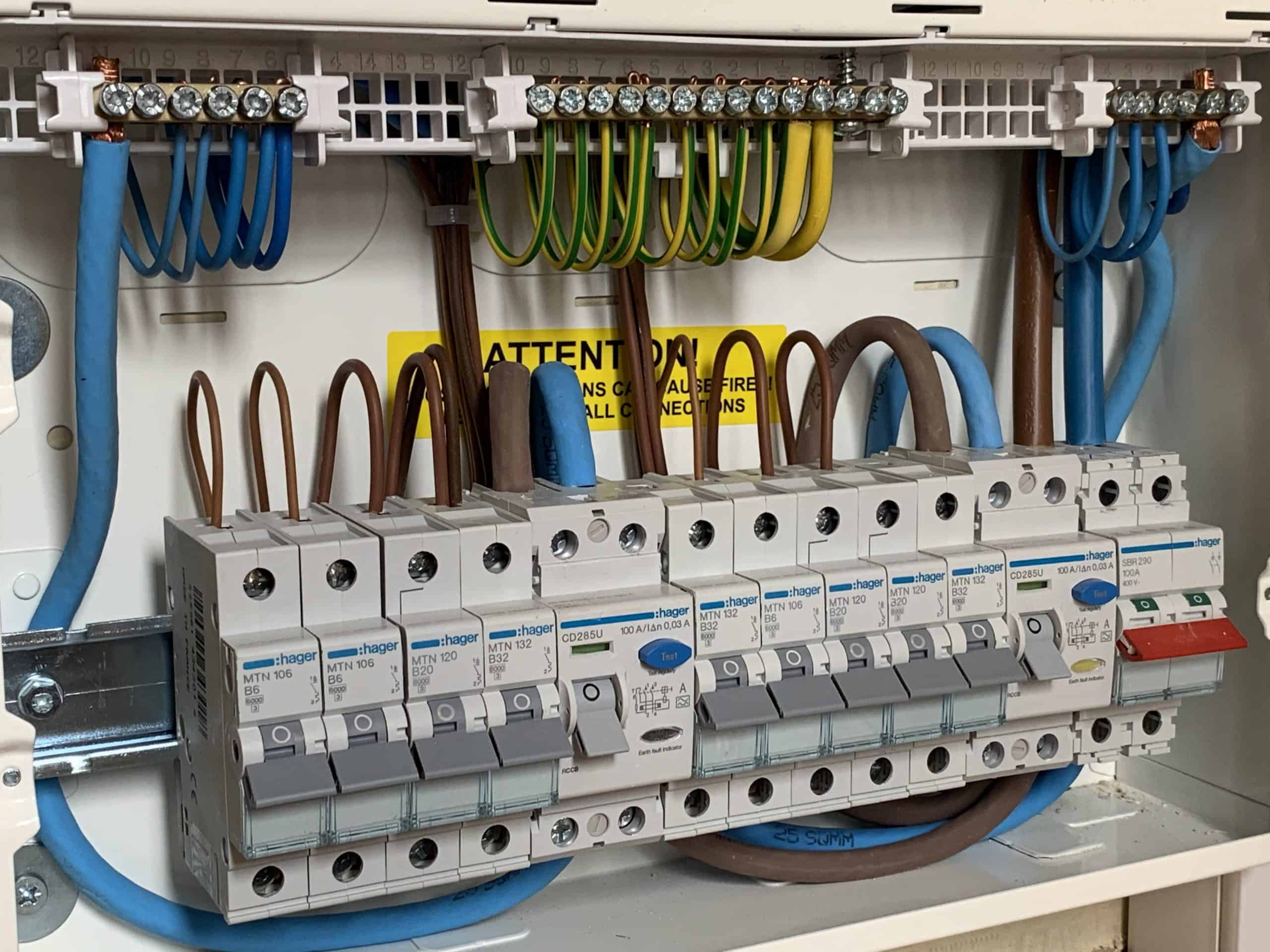
Every full rewire includes a new consumer unit. The current standard for a London residential rewire is an 18-way board with individual RCBO (Residual Current Breaker with Overcurrent protection) on every circuit. An RCBO-protected board provides both overcurrent and earth fault protection on each circuit independently. If one circuit trips on an earth fault, all other circuits remain live — this is a significant safety and convenience advantage over an older board protected by a single RCD.
Modern consumer units are metal-clad with a plastic fascia to comply with the amendment to BS 7671 that requires consumer units in domestic properties to be made from non-combustible material. Smart meter compatibility is standard in all new consumer units fitted by Prestige Engineers.
What Certification You Receive
On completion of a full rewire, the installing electrician issues an Electrical Installation Certificate (EIC). This is a formal document under BS 7671 signed by both the designer and the installer (in most cases the same person) certifying that the installation has been designed, installed, and tested in accordance with the wiring regulations. The EIC records every circuit on the installation, the test results for each circuit, and the protective device ratings.
The installation is then notified to the local authority under Part P of the Building Regulations. This notification is either carried out by a registered competent person scheme (NICEIC, NAPIT, or similar) or by the local authority building control directly. Prestige Engineers is NICEIC registered and handles Part P notification as part of every rewire. The homeowner receives a copy of the EIC and a Building Regulations compliance certificate.
Contact Prestige Engineers for a free rewire survey and fixed-price quote for any London property. We provide quotes for occupied and vacant properties and can advise on phasing the work to minimise disruption.