A complete guide to CIPP drain relining in London — how the no-dig repair process works, what conditions it can fix, and how much it costs compared to excavation.
What Is CIPP Drain Relining?
CIPP stands for cured-in-place pipe. It is a method of repairing a damaged underground drain without excavating the ground above it. Instead of digging up your garden, patio, or driveway to reach the broken pipe, a new structural pipe is created inside the old one using a resin-impregnated liner. The result is a smooth, jointless pipe within the original pipe that restores structural integrity and seals all cracks, gaps, and displaced joints. CIPP drain relining has been used in London and across the UK for over 30 years and is now the preferred method for most residential and commercial drain repairs where excavation can be avoided.
How CIPP Drain Relining Works: Step by Step
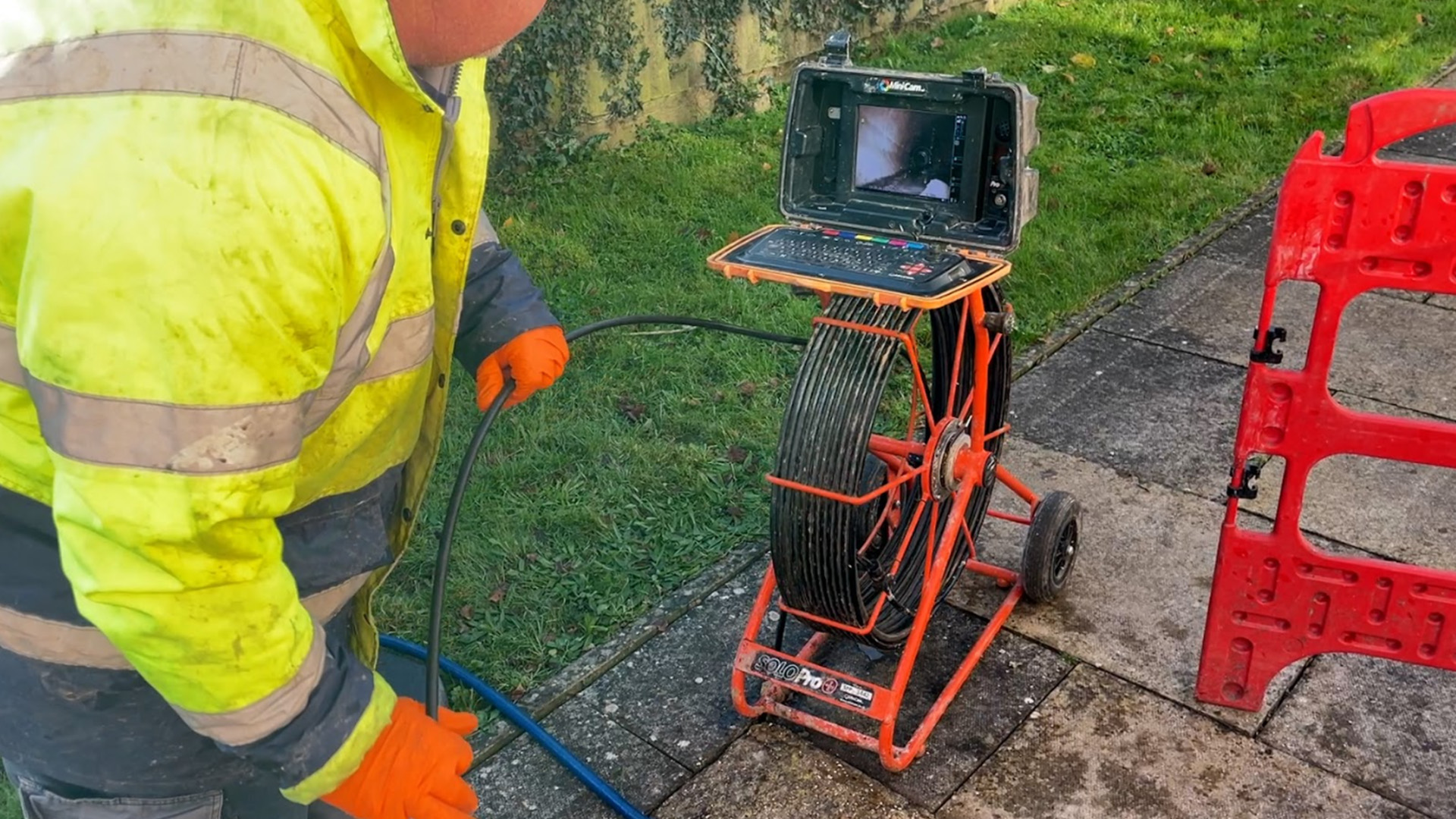
The process begins with a CCTV drain survey to assess the full extent of the damage and confirm that the pipe retains enough of its original shape to accept a liner. A collapsed section that has lost its circular profile cannot be relined — it must be excavated and replaced. Where the pipe is suitable, the process proceeds as follows.
Step 1: Drain cleaning. High-pressure water jetting clears the drain of all debris, root material, grease build-up, and loose fragments of the original pipe. The drain must be clean and clear before the liner is inserted. Any root intrusion is cut back using a rotary cutter first, then the drain is jetted to remove the cuttings.
Step 2: Liner preparation. The liner is a felt or fibreglass tube impregnated with a two-part epoxy or polyester resin. The liner is cut to the exact length required and the resin is mixed and applied under controlled conditions immediately before insertion. The impregnated liner is then loaded onto the inversion equipment.
Step 3: Liner insertion. Using an inversion drum and compressed air or water pressure, the liner is turned inside-out as it is pushed through the drain from the access point. As the liner inverts, it presses against the inner wall of the existing pipe along its full length. The resin-coated surface of the liner faces outward and contacts the pipe wall.
Step 4: Curing. Once the liner is in position, it is cured. Most residential CIPP relining in London uses hot water curing — hot water is circulated through the liner to accelerate the resin cure to full hardness. This typically takes 30 to 90 minutes depending on the liner diameter and length. Some commercial applications use UV light curing, which is faster but requires specialist equipment.
Step 5: Post-installation CCTV survey. After curing, the installation equipment is removed and a CCTV camera is passed through the relined pipe to confirm the liner has fully bonded to the pipe wall, there are no bridging or voids, and the new pipe bore is clear and correctly formed. Any lateral connections that were sealed by the liner are reinstated using a robotic cutter.
What Defects CIPP Relining Can Repair
- Cracks and fractures in the pipe wall — sealed by the resin liner
- Displaced joints — bridged and sealed by the continuous liner
- Root intrusion — the joint gaps through which roots entered are sealed, preventing regrowth
- Corrosion and surface deterioration — the liner provides a new smooth bore regardless of the original pipe surface condition
- Minor deformation — where the pipe oval is not severe, a liner can be inserted and will restore the original internal dimensions on curing
What CIPP Relining Cannot Repair
CIPP relining is not suitable for every situation. A pipe section that has completely collapsed — where the crown of the pipe has fallen in and the bore is no longer continuous — cannot be relined because the liner cannot pass through. A severely offset joint where one pipe section has shifted significantly sideways relative to the next section may prevent liner insertion. In these cases, localised excavation and pipe replacement is required for the collapsed or severely offset section, after which the remaining pipe can be relined if suitable.
CIPP Drain Relining Costs in London
CIPP drain relining costs in London are driven by the length of the liner required, the diameter of the pipe, the depth and accessibility of the access points, and whether any preparatory work such as root cutting is needed. Indicative costs for residential drain relining in London are as follows:
- Single short section (up to 3 metres): £800 to £1,500
- Full drain run (6 to 10 metres): £1,500 to £3,000
- Longer commercial or whole-property drain runs: £3,000 to £8,000+
By comparison, excavation and replacement of a 3-metre drain section in London typically costs £3,000 to £8,000 depending on depth, access, and whether hard surfacing needs to be broken and reinstated. In properties with basement levels, party walls, or extensive paved gardens — which describes a large proportion of London properties — the cost advantage of relining is even more pronounced.
Why Relining Is the Preferred Choice in London
London presents particular challenges for drain excavation. Many residential properties have small rear gardens with limited access for excavation equipment. Some drain runs pass under extensions, conservatories, or shared party walls where excavation would require underpinning and structural surveys. In these situations, CIPP relining offers the only practical repair option. The guarantee on a properly installed CIPP liner is typically 10 years, and the design life of a CIPP liner in normal conditions is in excess of 50 years.
Prestige Engineers carries out CCTV drain surveys and CIPP relining across all London boroughs. We provide a written fixed-price quote following the initial survey so you can compare the cost of relining against excavation before committing to a repair method.