A technical guide to CIPP (cured-in-place pipe) drain lining — materials, curing methods, liner types, quality standards and how to assess whether a liner has been installed correctly.
What Is CIPP?
CIPP stands for cured-in-place pipe. It is a generic term for a family of trenchless rehabilitation methods in which a fabric or composite liner impregnated with a thermosetting resin is inserted into a deteriorated pipe, shaped to the pipe bore by internal pressure, and cured in place to form a new structural pipe within the original host pipe. CIPP has been used for the rehabilitation of water mains, sewer mains, and private drainage since the early 1970s. The first commercial CIPP installation was carried out in London in 1971 by Insituform, the company that patented the inversion process.
CIPP is now the most widely used structural rehabilitation method for pipes in the 100mm to 900mm diameter range. In the residential drain market in the UK — and particularly in London, where Victorian clay pipe drainage is ubiquitous — CIPP relining has become the standard repair method for cracked, root-damaged, and displaced-joint drains where excavation is not practicable.
Liner Materials
The most common liner material for residential CIPP in the UK is a non-woven polyester felt tube. The felt provides the structural carrier for the resin and determines the wall thickness of the finished liner. Felt thickness is selected based on pipe diameter, host pipe condition, and the structural loading the liner needs to withstand — a liner in a drain beneath a vehicle access path requires a thicker wall than one in a pedestrian garden.
Fibreglass (glass reinforced plastic or GRP) liners are used for larger diameter pipes, for pipes subject to significant structural loading, and for long-distance lining where the higher modulus of elasticity of GRP provides better structural performance. GRP liners are standard in main sewer rehabilitation.
The choice of liner material and wall thickness should be specified following a structural calculation that considers the pipe diameter, the depth of cover, the soil loading, and any surface loading above the pipe. For residential drain relining in London, a felt liner of 4mm to 8mm wall thickness in a 100mm to 150mm pipe is typical.
Resin Systems
Two resin systems are in common use for CIPP in the UK residential market.
Polyester resin is the most widely used system. It is two-part, mixed immediately before impregnation, and provides a cure time and temperature profile that suits hot water curing in residential pipework. Polyester-resin liners are lower cost than epoxy alternatives and provide adequate structural performance for most residential applications.
Epoxy resin provides superior chemical resistance, higher flexural strength, and better adhesion to the host pipe wall. Epoxy CIPP liners are used in chemical drainage systems, food industry drainage, and in applications where long-term performance in aggressive effluent is a priority. In residential London drainage — where the effluent is domestic sewage in clay or PVC pipe — polyester resin is standard.
Curing Methods
Hot water curing is the most common method for residential CIPP in the UK. Water heated to 60 to 80 degrees Celsius is circulated through an inflated liner to initiate and complete the resin cure. Cure times range from 30 minutes for a short 100mm liner to 2 hours for a long 150mm liner. Hot water curing requires a boiler unit on site and is generally carried out using a closed-loop system in which the hot water is recirculated rather than discharged to drain.
UV curing uses an ultraviolet light train pulled through the liner to initiate photopolymerisation of a UV-sensitive resin. UV curing is faster than hot water curing for large-diameter pipes and provides very uniform cure quality because the cure front follows the light train precisely. UV CIPP is more capital-intensive and is most commonly used in main sewer rehabilitation.
Ambient temperature curing is possible with some resin formulations that cure at ambient ground temperature over 6 to 24 hours. Ambient cure systems are used in specialised applications but are not standard for residential drain relining.
Liner Types for Residential Drains
Full-length liner: A liner that runs the full length of the drain run from one access point to the next, or from the access point to the connection with the public sewer. Used where defects are distributed along the drain run.
Short patch liner: A liner of 0.5 to 3 metres inserted to cover a localised defect — a single displaced joint, a crack, or a small section of root intrusion. Installed using a packer rather than the full inversion process.
Lateral launch liner: A specialised liner for the connection between a property drain (lateral) and the main sewer. The lateral launch liner is deployed robotically from inside the main sewer or from the lateral access point and seals the junction from both inside the lateral and inside the main pipe.
Quality Assessment: What a Good Installation Looks Like
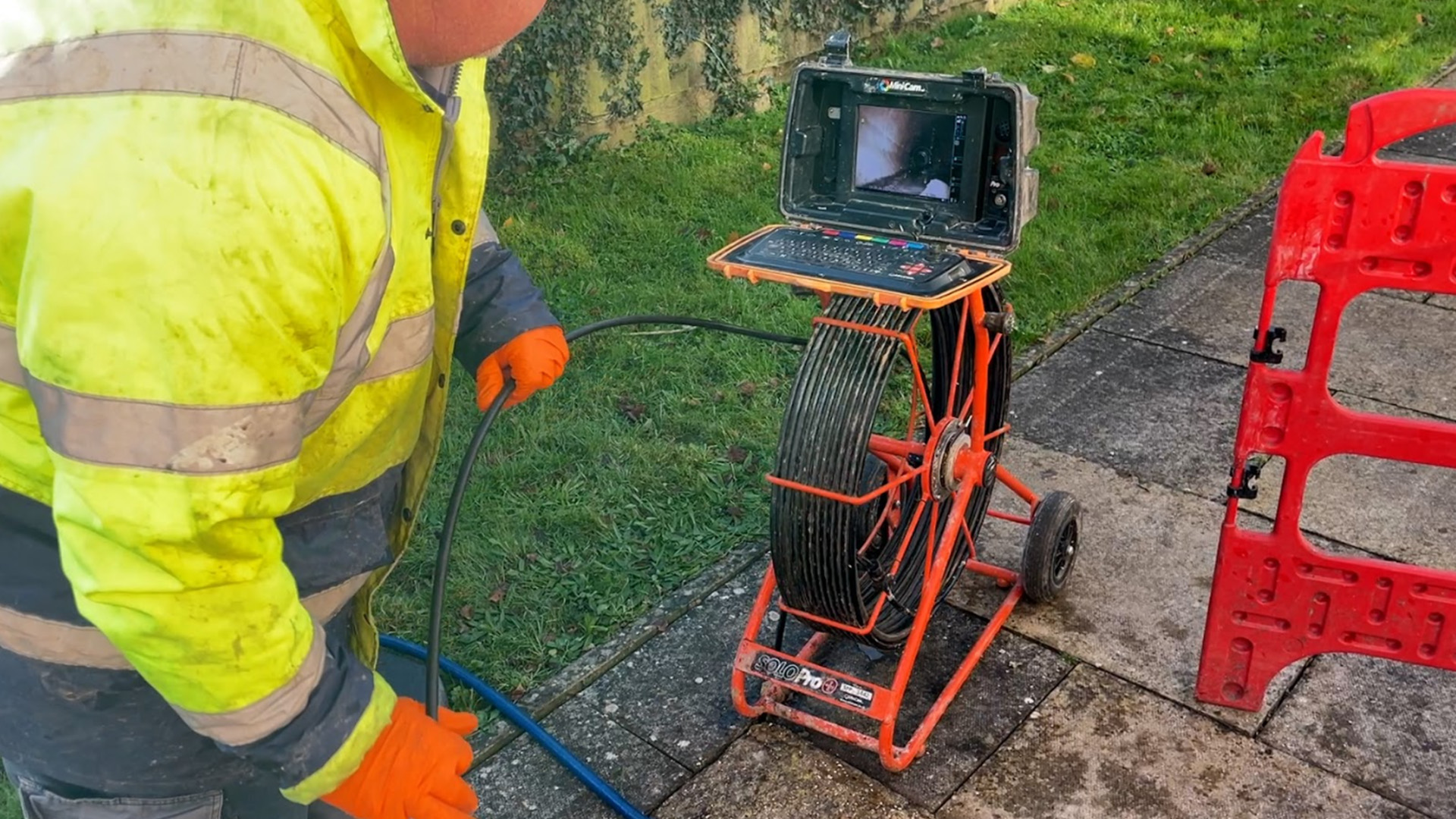
The post-installation CCTV inspection is the primary quality control tool for CIPP relining. A correctly installed liner should show: complete contact with the host pipe wall along its full length with no voids or bridging; a smooth, uniform bore with no wrinkles or folds; clean reinstatement of all lateral connections; and clean terminations at both ends of the liner flush with the access chamber or rodding eye.
Any void between the liner and the host pipe wall represents an area where the liner has not bonded and where groundwater ingress or root intrusion could occur in future. A bridging wrinkle in the liner reduces the pipe bore at that point and can trap solids. Both are evidence of poor installation quality.
Prestige Engineers provides a written post-installation CCTV report with video and still images confirming the quality of every relining installation. Contact us for a CCTV survey and fixed-price relining quote across all London boroughs.