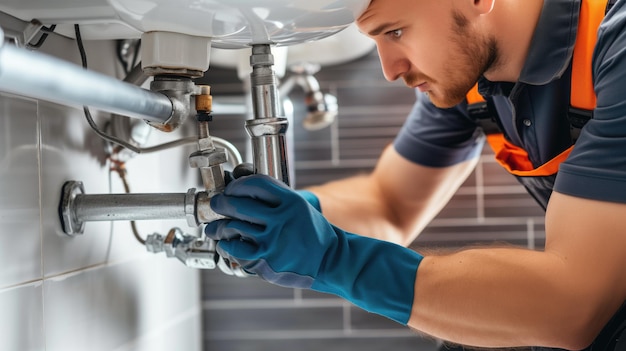
A guide to under-sink water filter installation in London -- covering filter types, the plumbing connections required, compatibility with boiling water taps, and the practical difference between a filter and a water softener.
Why London Homeowners Install Under-Sink Water Filters
London mains water is safe to drink and meets all regulatory standards set by the Drinking Water Inspectorate. However, many London homeowners and tenants find the taste, the hardness, and the chlorine content of the mains supply unsatisfactory. An under-sink water filter improves the taste and reduces the chlorine by-products and particulate matter in the supply without the complexity or cost of a whole-house water treatment system. For properties with a boiling water tap (Quooker, Zip HydroTap), a scale-inhibiting filter on the supply line is strongly recommended given London hard water conditions.
Types of Under-Sink Water Filters
The most common under-sink filter type is the single-stage or multi-stage cartridge filter. A single-stage filter typically contains an activated carbon block that removes chlorine, chloramines, and taste and odour compounds but does not address water hardness. A multi-stage filter adds a sediment pre-filter and may include a polyphosphate stage for scale inhibition. Multi-stage systems suitable for London properties typically have two or three housings, each containing a different filter medium, connected in series on the supply line.
Reverse osmosis systems (RO) are a more sophisticated option that passes water under pressure through a semi-permeable membrane, removing dissolved minerals, heavy metals, nitrates, and most organic compounds. The output is very pure water with minimal mineral content. RO systems also reduce the water hardness to near zero -- useful for a boiling water tap in a hard water area. The limitation of RO is the waste water ratio: for every litre of filtered water produced, two to four litres of waste water are discharged to the drain. In London properties with water-efficient habits, this inefficiency can be a deterrent. RO systems also require more under-sink space for the membrane housing, pre-filter cartridges, and the pressurised storage tank.
Plumbing Connections Required
An under-sink cartridge filter is installed by fitting a saddle valve or a tee on the cold supply pipe under the sink, running a 10 to 15 mm supply to the filter housing inlet, and connecting the filter outlet to a dedicated filtered water tap on the sink deck or to the cold supply of a boiling water tap. The filtered water tap is typically a separate small tap fitted through an additional hole in the sink or worktop alongside the main mixer tap. The installation can be completed in one to two hours by a plumber with the required fittings and does not require any electrical supply.
A reverse osmosis system requires the same cold supply connection plus a 10 mm drain connection routed to the sink waste for the reject water output, and a connection to a pressurised storage tank. The tank holds the filtered water under pressure so that the tap delivers a good flow rate despite the low output rate of the RO membrane. A standard under-sink RO system produces approximately one to two litres per hour of filtered water, so the storage tank (typically 10 to 12 litres) ensures adequate flow at the tap during normal use.
Boiling Water Tap Compatibility
Quooker, Zip HydroTap, and most other boiling water tap manufacturers supply a proprietary filter that is installed on the cold supply to the tap tank. This filter is designed to work with the specific system and must be used to maintain the product warranty. The filter reduces particulate matter and chlorine taste but is typically not a scale inhibitor -- it does not prevent calcium scale accumulation in the tank in London hard water conditions. Some Quooker models are compatible with an additional CUBE cold water filter that also provides sparkling water from the tap unit; this requires a CO2 cartridge connection in the under-sink space.
For heavy scale accumulation in the boiling water tap tank, a polyphosphate dosing cartridge fitted on the supply line upstream of the tap filter is the most practical scale management solution. These cartridges release small quantities of food-grade polyphosphate into the supply water, which coats the mineral particles and inhibits scale formation on heated surfaces. Cartridges must be replaced every three to six months.
Maintenance Requirements
Cartridge filters must be replaced at the interval specified by the manufacturer -- typically every six to twelve months depending on the flow volume and the water quality. A neglected filter cartridge becomes a colonisation site for bacteria and may degrade the water quality rather than improving it. Most filter housings have a transparent body or an indicator that shows when the cartridge requires replacement. RO membranes have a longer service life -- typically two to three years -- but the pre-filter cartridges must still be replaced at the standard interval.
Installation Cost
Under-sink water filter installation in London: single or dual-stage cartridge filter system -- supply and fit including filter housing, cartridges, saddle valve, and filtered water tap £200 to £400. Reverse osmosis system supply and fit including membrane housing, pre-filters, storage tank, and filtered water tap £400 to £700 depending on the system specification. Filter cartridge replacement service (annual) £80 to £150 depending on the system type.