Leak Detection — London
Water leak detection in London
Non-invasive acoustic and thermal leak detection across all 33 London boroughs. We find the leak before we open anything up. Trace-and-access reports for buildings insurance. Repair and reinstatement by our own engineers.
About this service
Leak detection London — how it works and why it matters
Non-invasive leak detection methods
Finding a hidden water leak without tearing up floors or opening walls requires specialist equipment and the experience to interpret what it is telling you. Prestige Engineers carries three distinct detection technologies to every survey, deploying them in combination as the situation demands.
Acoustic leak detection is the cornerstone of most residential surveys. Our listening devices are placed on pipe access points — the stopcock, isolation valves, meter — and pick up the distinctive sound signature of water escaping under pressure. Because the signal intensity increases as the sensor moves closer to the source, we can walk the pipe route and identify the precise location to within a few centimetres. No floor tiles need to come up, no walls need to come down, until we know exactly where we are going.
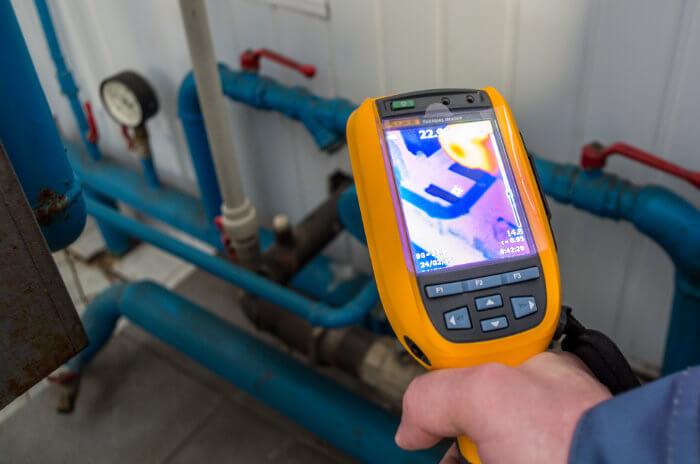
Thermal imaging works on a different principle entirely. Water conducts and retains heat differently to concrete, timber and plasterboard — a wet area beneath a screed floor stays measurably cooler than its surroundings. Our thermal cameras capture this temperature differential as a vivid colour map, making leaks from underfloor heating circuits and concealed waste pipes immediately visible. We can show you the image in real time on-site.
Tracer gas detection is reserved for cases where acoustic signal is attenuated by thick concrete screed or deep burial depth. A food-safe hydrogen/nitrogen mixture — 5% hydrogen, 95% nitrogen — is injected into the isolated pipe system. Hydrogen molecules are small enough to travel through concrete and rise to the surface at the leak point, where a calibrated electronic probe detects the gas. This method is effective even through 200mm of dense screed that would defeat acoustic techniques.
Why precise leak detection matters in London
London property values are among the highest in the world. The cost of unnecessary excavation, floor lifting and reinstatement — in Victorian terrace houses with original encaustic tile floors, in converted warehouse apartments with polished concrete, in modern flats with large-format porcelain — can run to tens of thousands of pounds. Identifying the leak location precisely before any opening-up begins is not a luxury; it is the difference between a half-day repair and a month-long programme of works.
The most common sources of hidden leaks in London properties divide by property age. In Victorian and Edwardian stock, underground supply pipes are frequently original lead or early copper, corroded at joints and fittings. These pipes run under floors, through wall cavities and occasionally beneath garden paths before entering the property — they are invisible until they fail. In modern builds completed since the 1990s, underfloor heating systems with plastic push-fit pipework embedded in screed are a significant source of leaks, particularly at manifold connections. Shower trays and bath waste connections are a perennial source of hidden leaks regardless of property age — a slow drip from a poorly sealed trap can saturate the timber subfloor beneath a first-floor bathroom for months before the ceiling below shows any staining. Flat roof drainage connections are another common source, particularly in converted commercial buildings.
Prestige Engineers is Gas Safe registered and holds over 180 verified reviews across Checkatrade (60 reviews) and MyBuilder (120 reviews). We cover all 33 London boroughs from our base in London and attend same-day for emergency surveys. You will receive clear pricing before any work starts — no surprises when the invoice arrives.
Insurance-approved leak detection reports
Our leak detection methodology and report format are accepted by all major UK home insurers. If you are making a buildings insurance claim under your trace-and-access cover, we can provide the formal report your insurer requires — including methodology description, equipment serial numbers and calibration records, photographic evidence of the detection process, annotated location drawings, and a schedule of opening-up and reinstatement works. We are experienced working directly with loss adjusters and claims handlers, which reduces the administrative burden on you as the policyholder.
Most standard buildings insurance policies include trace-and-access cover up to a limit of £5,000–£10,000. This covers the cost of finding the leak and making good any surfaces opened to access it — it does not normally cover the repair of the leaking pipe itself, which insurers treat as a maintenance item. We advise you on your likely policy position before starting work so there are no surprises.
Signs you have a hidden leak — and what to check first
An unexplained rise in water bills is the most reliable indicator of a hidden leak. Thames Water customers can check their usage online; a doubling of consumption with no change in household behaviour points strongly to a leak on the supply side. Other warning signs include damp patches appearing on walls or ceilings with no obvious source — particularly on ground floor ceilings, which lie directly above buried pipework — a sustained drop in water pressure across the property, soft spots or slight yielding underfoot on tiled floors, and mould growth appearing in areas that have not previously been affected.
Thermal imaging surveys are particularly effective for underfloor heating leaks and leaks behind tiles, where conventional acoustic methods struggle to penetrate the dense substrate. If you have warm spots or cold spots in the floor that do not correspond to the heating zone layout, or if sections of your underfloor heating have stopped working entirely, a thermal survey will identify the leak location without lifting a single tile.
Pricing guide
£200–£500
Leak detection survey
Survey price depends on property size, number of detection methods required and access complexity. Trace and access reinstatement works are quoted separately following detection. Clear pricing confirmed before any work starts.
- No call-out fee to quote
- Fixed price confirmed before work starts
- Insurance trace-and-access reports included
- Same-day surveys available
Why Prestige
Gas Safe registered
Fully certified engineers for all gas and plumbing work
180+ verified reviews
60 on Checkatrade, 120 on MyBuilder
All 33 London boroughs
Single point of contact across Greater London
Same-day attendance
For emergency leak surveys
Insurance-approved reports
Accepted by Aviva, RSA, Allianz, Zurich, AXA and all Lloyd's syndicates
Detection methods
How we find hidden leaks
We select the most appropriate detection method for your property type and the nature of the leak. In most cases, a combination of methods is used to confirm the location before any opening-up takes place.
Acoustic leak detection
The primary method for most residential leak detections. We place acoustic sensors on pipe access points, valves, stopcock and meter. Pressure wave analysis and correlation algorithms pinpoint the leak location to within centimetres along the pipe run. Non-invasive — no opening up required until the exact location is confirmed.
Best for: Buried supply pipes, pipe runs under screeded floors, heating circuits
Thermal imaging
A thermal camera detects temperature differences as wet materials cool differently to dry ones. Particularly effective for leaks under solid floors (the wet area stays cooler) and leaks within stud walls. Results are instant and highly visual — we can show you the thermal map on screen during the survey.
Best for: Under-screed heating pipework, wet walls, ceiling leaks from above
Tracer gas detection
Food-safe hydrogen/nitrogen gas mixture (5% H2, 95% N2) is injected into the isolated pipe system. The gas escapes through the leak point and rises to the surface, where a highly sensitive electronic probe detects the trace gas. Effective on heavily screeded floors where acoustic signal is attenuated.
Best for: Deep-buried pipes, screeded concrete floors, pipes within inaccessible voids
Endoscopic inspection
A flexible camera on a probe inspects pipe interiors, wall cavities and floor voids without full opening up. Used to confirm a suspected leak location before committing to opening up, and to inspect the condition of pipework that will require replacement.
Best for: Confirming suspected locations, inspecting void spaces, pipe condition assessment
Moisture metering
Calibrated moisture meters measure moisture content in walls, floors and ceilings. Used to map the extent of water damage and track drying progress during reinstatement. Useful for identifying secondary damage caused by a slow leak that has been present for some time.
Best for: Mapping water damage extent, monitoring drying, documenting insurance claims
Pressure testing
The supply system is isolated and pressurised to test for pressure loss over time. A failing pressure test confirms a leak exists and gives a quantitative measure of severity. Used to verify repair effectiveness after the leak has been fixed and as a final commissioning test.
Best for: Confirming leak presence, verifying repair effectiveness, pre-purchase checks
Insurance claims
Trace-and-access reports for insurance
Most standard buildings insurance policies include trace-and-access cover — the cost of finding a hidden leak and reinstating any surfaces opened to access it. The policy typically does not cover the repair of the leaking pipe itself, which is considered wear and maintenance.
We produce formal trace-and-access reports including: methodology used, equipment serial numbers and calibration records, photographic evidence of the detection process, location drawings, and a schedule of opening-up and reinstatement works. These reports are accepted by all major London insurers.
We work directly with loss adjusters and claims handlers on request, and can provide variation instructions as additional damage is uncovered during opening-up.
Insurance leak enquiryReport format
Accepted by Aviva, RSA, Allianz, Zurich, AXA, Direct Line and all Lloyd's syndicates
Trace-and-access limits
We advise on your policy limit before starting — typical limits are £5,000-10,000
VAT treatment
Trace-and-access works on residential property are VAT-exempt when forming part of a claim
Turnaround
Reports issued within 24-48 hours of site survey completion
Managed process
We liaise directly with loss adjusters on request, reducing the administrative burden on the policyholder
Warning signs
Signs you may have a hidden water leak
Unexplained increase in water bills with no change in usage
Damp patches or staining on walls, ceilings or floors
Mould or mildew appearing in areas not previously affected
Sound of running water when all taps and appliances are off
Reduced water pressure at taps or shower
Warm or cold spots on floors — particularly tiled floors
Bubbling or blistering paintwork on walls
Musty smell in a room with no obvious cause
Water meter reading moving with all supply isolated inside the property
FAQ
Leak detection questions
How do you find a hidden water leak without damaging the property?
We use several non-invasive methods to locate hidden leaks. Acoustic leak detection uses highly sensitive microphones placed on pipe access points to listen for the distinctive sound of escaping water — the closer to the source, the louder the signal. Thermal imaging cameras detect temperature differentials caused by water evaporating through floor or wall surfaces. Tracer gas (hydrogen/nitrogen mixture) is injected into the pipe system and detected at surface level using a probe — the gas escapes through the leak point and rises to the surface. Moisture meters can confirm dampness levels in walls, floors and ceilings. Together these methods allow us to locate most leaks to within a few centimetres before any opening-up is needed.
How much does leak detection cost in London?
Acoustic leak detection for a residential property in London typically costs £150-300 for the detection survey. More complex investigations requiring thermal imaging or tracer gas are £250-500. Trace-and-access work for buildings insurance claims is quoted according to the scope — we provide a detailed report suitable for your insurer. If we carry out the repair following detection, the detection fee is often reduced or offset against the overall job cost.
My water bill has increased but I cannot see a leak — what should I do?
An unexplained increase in water bills is a classic sign of a hidden leak. First, check by turning off all water use in the property and reading the water meter — if the dial still moves with everything off, there is a leak on the supply side. Check toilets for silent leaks (a few drops of food colouring in the cistern will show in the bowl within 15 minutes if the flapper seal is leaking). Check visible pipework under sinks and behind the boiler. If none of these are the source, a professional acoustic leak detection survey will identify the location without unnecessary damage.
Does insurance cover trace-and-access leak detection?
Most standard buildings insurance policies include trace-and-access cover, which pays for the cost of locating a hidden leak and reinstating any surfaces opened up to access it — but typically not the repair of the leaking pipe itself. Check your policy schedule for the trace-and-access limit (commonly £5,000-10,000). We provide a formal trace-and-access report in the format required by all major insurers including Aviva, RSA, Allianz, Zurich and Lloyd's syndicates.
How quickly can you locate a leak in London?
Most leak detection surveys for a residential property in London take 2-4 hours on-site. We aim to identify the leak location in a single visit using a combination of acoustic, thermal and tracer gas methods as required. Complex cases (concrete ground floor slabs, multiple possible sources, low water pressure) may require a follow-up visit. Same-day surveys are available for urgent cases.
Suspect a hidden leak in your London property?
We find it before we open anything. Same-day surveys available.