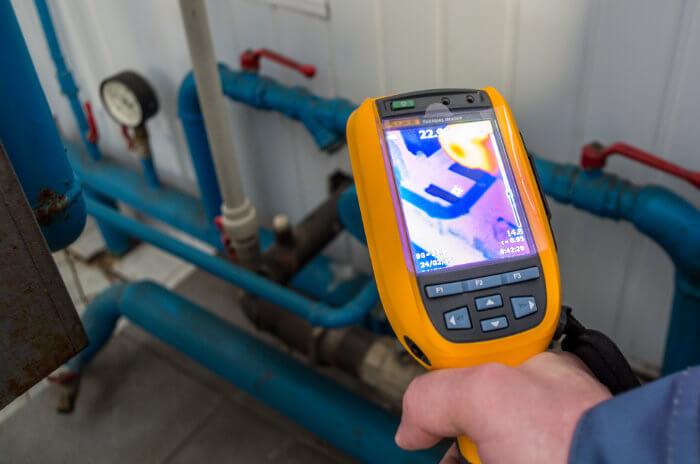
Thermal imaging cameras detect temperature differences caused by water leaks in walls, floors, and ceilings. This guide explains how thermal imaging works as a leak detection tool, its limitations, and what it costs in London.
How Thermal Imaging Detects Water Leaks
A thermal imaging camera (also called an infrared camera or thermographic camera) detects infrared radiation emitted by every surface and converts it into a visual image where different temperatures are displayed as different colours. Hot surfaces appear red or yellow; cold surfaces appear blue or purple; surfaces at ambient temperature appear green or teal. The camera does not see through walls — it reads the surface temperature of whatever it is pointed at. The power of thermal imaging for leak detection lies in the fact that a water leak changes the temperature of the surrounding structure, and this temperature change is visible on the surface of the wall, floor, or ceiling above or adjacent to the leak.
A cold water leak cools the surrounding material. In a wall with a leaking cold water pipe, the area around the pipe will be cooler than the surrounding dry wall and will appear as a cooler patch on the thermal image. A hot water or central heating pipe leak warms the surrounding material — the affected area appears warmer than the surrounding structure on the thermal image. A leak behind a plasterboard wall, under a timber floor, or within a ceiling void will produce a thermal signature that can guide the investigation to the right area without random opening up of surfaces.
Conditions Required for Effective Thermal Imaging
Thermal imaging works best when there is a temperature difference between the leak and the surrounding material. The greater the temperature differential, the clearer the thermal signature. There are conditions that affect the reliability of thermal imaging surveys in London properties.
Time of day and weather. Thermal imaging of external walls is most effective when conducted at night or in the early morning, when the wall surface has had time to cool from solar gain during the day. A wall that has been heated by direct sunlight will show a uniform warm signature that can mask cold leak patches. Overcast conditions with low solar gain produce better results than bright sunny days for thermal surveys of external walls.
Delta T (temperature differential). Thermal imaging requires a minimum temperature differential of approximately 5 to 10 degrees Celsius between the room and the external environment to produce reliable results for most applications. In summer when internal and external temperatures are similar, the technique is less effective than in winter when there is a significant temperature gradient through the structure.
Active versus inactive leaks. A leak that has been running continuously will have established a thermal signature in the surrounding material. An intermittent leak that has stopped will gradually allow the affected area to return to ambient temperature, reducing the thermal signature over time. For best results, thermal imaging should be conducted while the leak is active or immediately after it has been running.
What Thermal Imaging Can and Cannot Find
Thermal imaging is highly effective for locating leaks from hot water pipes and central heating pipework within walls and floors, leaks from underfloor heating circuits, cold water leaks in well-insulated walls where the temperature differential between the leak and the surrounding structure is sufficient, flat roof moisture mapping (identifying where water has penetrated and saturated the roof insulation), and leaks from concealed showers, baths, and basin traps where water has been tracking through the structure for some time.
Thermal imaging is less effective for very small or intermittent leaks that have not produced a significant temperature change in the surrounding material, for leaks behind thick masonry walls where the thermal signal from the pipe does not reach the wall surface, and for underground leaks outside the building where ground thermal mass absorbs the temperature differential.
For underground supply pipe leaks — the most common leak type in London Victorian properties — acoustic correlation and ground microphone surveys are more effective than thermal imaging. Thermal imaging is the preferred tool for internal leaks within the building structure.
Cost of Thermal Imaging Surveys in London
A thermal imaging survey of a typical London residential property costs £200 to £350 depending on property size and the number of suspect areas. A combined survey including both thermal imaging (for internal structure) and acoustic detection (for underground pipes) costs £300 to £500 and provides the most comprehensive investigation for a property with a leak of uncertain location. All surveys from Prestige Engineers include a written report with thermal images and interpretation, suitable for submission to a buildings insurer under the trace and access clause.
Contact Prestige Engineers to arrange a thermal imaging or combined leak detection survey across any London borough. We typically attend within 24 to 48 hours of enquiry.