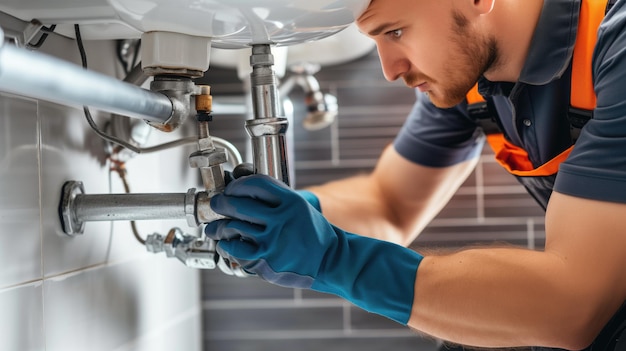
London's plumbing market ranges from fully qualified Gas Safe engineers with public liability insurance to unregistered handymen working without the skills or cover the job requires. Knowing what to look for before booking, what to ask on the first call, and what a fair price looks like for common jobs will help you avoid the most frequent and costly hiring mistakes.
Finding a reliable plumber in London is not as straightforward as it should be. The trade is unregulated for general plumbing (as opposed to gas work, which requires Gas Safe registration), meaning anyone can legally describe themselves as a plumber without formal qualifications. The result is a wide variation in quality — and hiring the wrong person for the wrong job can leave you with a larger problem than you started with.
What Qualifications Should a Plumber Have?
For general plumbing — installation, maintenance and repair of water supply, drainage and sanitary systems — there is no legal requirement for the plumber to hold any specific qualification. However, a plumber with NVQ Level 2 or 3 in Plumbing and Domestic Heating, or equivalent City and Guilds qualifications, has demonstrated a minimum standard of competence.
Scheme membership is the most practical proxy for quality:
- WaterSafe (watersafe.org.uk) — the industry-backed register for plumbers approved to work on water fittings. Members must hold relevant qualifications and are subject to ongoing assessment. For any work affecting the water supply (new connections, hot water systems, booster pumps), using a WaterSafe-approved plumber is advisable.
- Gas Safe Register (gassaferegister.co.uk) — legally required for any work on gas appliances. Every engineer listed holds a valid Gas Safe ID card specifying which appliance types they are qualified to work on. Always check an engineer's card before any gas work begins — you can also verify registration online.
- APHC (Association of Plumbing and Heating Contractors) — a trade association whose members must hold relevant qualifications and adequate insurance.
What Questions to Ask Before Booking
On the first call, ask:
- Are you Gas Safe registered? (If the job involves gas work)
- Are you WaterSafe approved?
- Do you carry public liability insurance? What is the cover level?
- Can you provide a written quote or estimate before starting?
- Do you charge a callout fee separately from the job, and if so what is it?
- Are you available to start within my required timeframe?
A plumber who is unable or unwilling to answer these questions clearly, or who insists on cash payment with no written quote, should be treated with caution.
Typical Costs for Common Plumbing Jobs in London
London plumbing rates are higher than the national average, reflecting higher operating costs, congestion charge zones and above-average labour market rates. As a rough guide at mid-2025 rates:
- Callout and first hour: £80–£150 for standard hours; £150–£250 for emergency callouts outside business hours
- Tap washer or cartridge replacement: £80–£150 all-in (parts plus one hour labour)
- Toilet repair (cistern components): £100–£200 depending on parts required
- Blocked drain clear (rodding): £100–£200; CCTV survey and jetting: £200–£400
- Boiler service: £80–£120
- Combi boiler replacement (supply and install): £1,800–£3,000 depending on spec and any associated pipework alterations
- Annual gas safety inspection (CP12): £60–£100 for a single appliance
These figures are starting points — complexity, access difficulty (particularly in Victorian buildings with original pipework runs), parts availability and urgency all affect final costs. Always get a written quote or written confirmation of the hourly rate before work commences.
How to Avoid Common Pitfalls
- Do not pay in full upfront. A reputable plumber will typically ask for a deposit on larger jobs (boiler replacement, bathroom installation) but should not demand full payment before completing the work.
- Get a written quote, not just a verbal estimate. A verbal estimate has no evidential weight if a dispute arises over final costs.
- Clarify whether quoted prices include parts and VAT. Labour-only quotes can look competitive until a large parts bill is added.
- Check reviews independently. Google and Trustpilot reviews are harder to manipulate than testimonials on the plumber's own website.
- Do not use an unregistered person for gas work. The legal and safety consequences are serious — an invalid Gas Safety Record can affect your landlord insurance and, in the event of an incident, your criminal liability.
Emergency Plumbing in London
For genuine emergencies — burst pipes, sewage backflow, boiler failure in cold weather — most London plumbing companies offer 24-hour emergency response. Emergency callout rates are typically double or more than standard day rates. If the emergency involves the gas supply, always call the National Gas Emergency Service (0800 111 999) first — this is free and they will attend within the hour.
For water supply emergencies — a burst pipe or loss of supply — the first action is to isolate the supply at the internal stopcock (usually under the kitchen sink or in the cupboard under the stairs). If the stopcock is inaccessible or will not turn, Thames Water's emergency line (0800 316 9800) covers supply-side emergencies outside the property boundary.
Frequently asked questions
Is any plumber legally qualified to carry out gas work in London?
No. All gas work — including boiler installation, servicing, repair and gas pipe work — must be carried out by a Gas Safe registered engineer. This is a legal requirement under the Gas Safety (Installation and Use) Regulations 1998. You can verify any engineer's registration at gassaferegister.co.uk.
What is the WaterSafe register and should I use a plumber listed on it?
WaterSafe is an industry register of plumbers who are approved to work on water fittings in compliance with Water Supply (Water Fittings) Regulations 1999. Membership requires relevant qualifications and ongoing assessment. For work affecting the water supply — including new hot water systems, booster pumps, or connections to the mains — using a WaterSafe-approved plumber is advisable and in some cases required.
What is a typical callout fee for a London plumber in an emergency?
Emergency callout fees in London typically range from £150 to £250 for the first hour outside standard working hours (evenings, weekends, bank holidays), compared to £80 to £150 during standard hours. Always confirm the callout fee, hourly rate and any additional charges before the plumber attends.
How do I find a reliable plumber in London quickly?
The most reliable route is a personal recommendation from a neighbour, letting agent or property manager who has used the plumber recently. WaterSafe.org.uk and Gas Safe Register allow postcode-based searches for registered engineers. Checking recent Google reviews (specifically looking at how the company responds to negative reviews) is a useful secondary check.