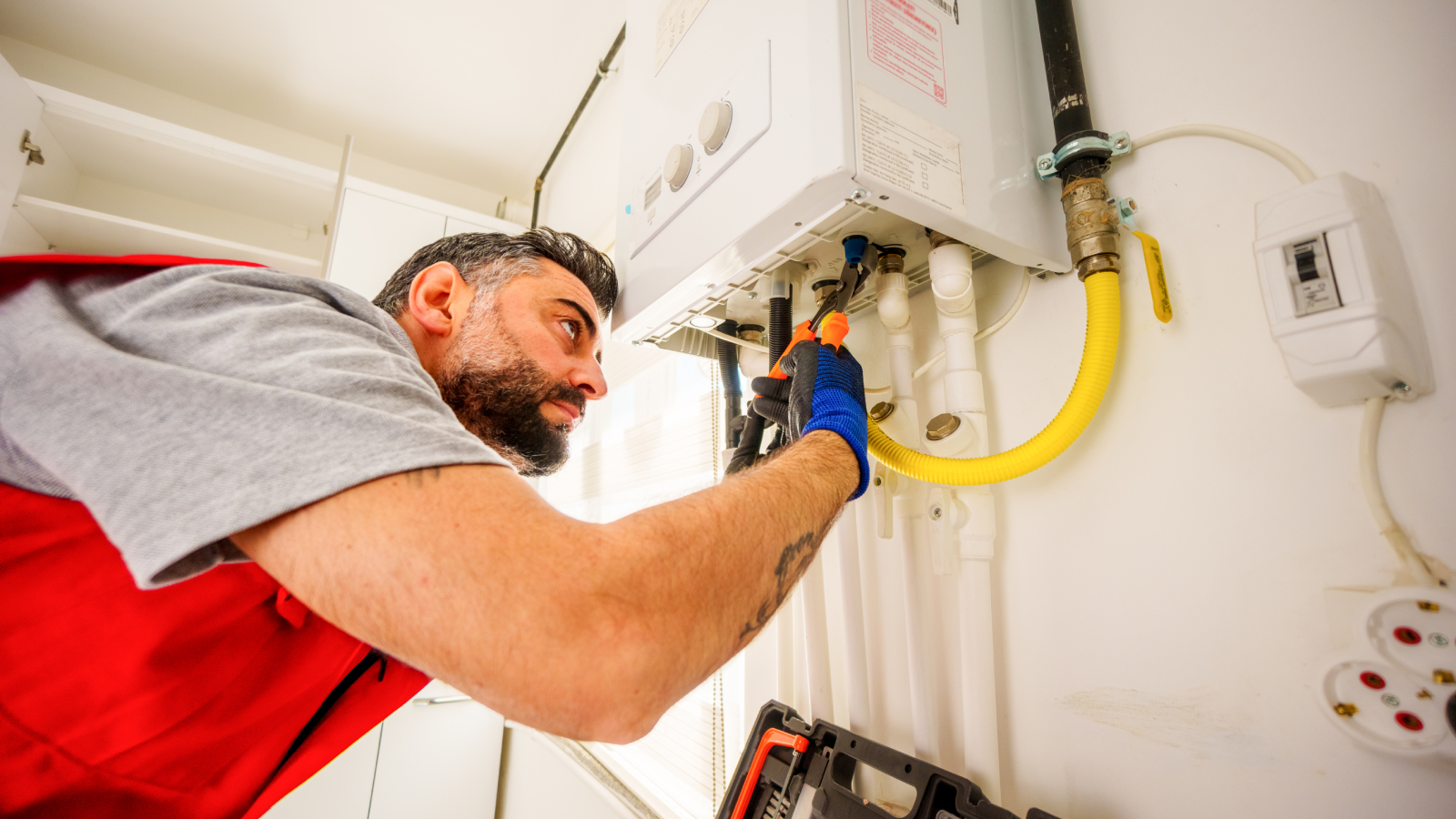
A boiler that bangs, whistles, kettles or rumbles when firing is telling you something is wrong. This guide explains what each noise means and whether it is an immediate safety concern or a maintenance issue.
Boiler Noises — What Each Sound Indicates
Kettling — Rumbling Like a Kettle Boiling
Kettling is the most common boiler noise in London properties — a loud rumbling or kettling sound when the boiler fires or during a heating cycle. It is caused by scale (calcium carbonate) depositing on the heat exchanger, forming a layer that overheats the water in contact with it. The overheated water vapourises and then recondenses — creating the characteristic kettling sound.
London postcodes SW, SE, E, NW, W, N all have hard water above 250mg/l — scale buildup on heat exchangers is virtually inevitable without a scale reducer or water softener.
Severity: Not immediately dangerous, but will progressively damage the heat exchanger. The boiler works harder, uses more gas, and the heat exchanger eventually fails prematurely. Address this within a few months.
Fix: A descaling treatment (hydrojet or chemical descale) by a Gas Safe engineer, combined with fitting a Combimate or Fernox scale reducer on the cold feed. Cost: £150-300 for descaling, £80-150 for scale reducer.
Banging When the Boiler Fires
A loud bang or thump specifically when the boiler ignites (at the start of a heating or hot water call) suggests delayed ignition — gas is accumulating in the combustion chamber before ignition, creating a small explosion when it finally lights.
Severity: Potentially serious — repeated delayed ignition can damage the heat exchanger and in severe cases cause a "puff back." Do not ignore this.
Cause: Dirty or worn ignition electrodes with carbon deposits (very common after 5+ years), partially blocked burner jets, or a gas valve that releases gas too slowly initially.
Fix: Gas Safe engineer to clean or replace ignition electrodes and inspect burner — typically done as part of or in addition to an annual service.
Banging in Pipes When Heating Starts or Stops
Banging or clicking in the pipework (not the boiler) when the heating fires up or shuts down is usually thermal expansion — pipework expanding and contracting as it heats and cools, knocking against joists, floorboards or pipe clips.
Severity: Not dangerous. However, if the noise is specifically at a single joint and there is also a damp patch, it may be a weeping joint.
Fix: Locate the pipe run causing the noise (trace the sound) and add rubber pipe clips or lagging at the contact points. This is an access job — floorboards may need lifting.
Whistling or High-Pitched Squealing
A whistling sound from the boiler during operation is usually air trapped in the heat exchanger or pump, or a partially blocked system restricting flow and creating turbulence.
Fix: Bleed air from the system (bleed radiators and the boiler's own bleed point), and check system pressure. If whistling persists, it may be a partially scaled heat exchanger — see kettling above.
Gurgling
Gurgling noises from the boiler or radiators indicate air in the system. Bleed all radiators and then the boiler if it has a bleed point. Check pressure after bleeding and top up if below 1 bar. If air keeps returning, there is either a micro-leak introducing air or an expansion vessel that has lost its pre-charge.
Frequently asked questions
Is a banging boiler dangerous?
It depends on the type of bang. A bang when the boiler first fires suggests delayed ignition — this should be investigated by a Gas Safe engineer promptly. A bang in the pipework when heating starts or stops is usually thermal expansion and not dangerous. If in doubt, call a Gas Safe engineer to diagnose.
Why does my boiler make a kettling noise in London?
Kettling is caused by calcium scale depositing on the heat exchanger — extremely common in London's hard water areas. Water overheats in contact with the scale and partially vapourises, creating the rumbling sound. It will progressively damage the heat exchanger. A Gas Safe engineer can descale the system; fitting a scale reducer prevents recurrence.
How much does it cost to fix a kettling boiler in London?
Descaling treatment: £150-300. Fitting a scale reducer (Combimate or Fernox): £80-150. System power flush (if sludge as well as scale): £400-650. The sooner kettling is addressed, the cheaper the fix — a fully scaled heat exchanger requiring replacement costs £400-800.
My boiler makes a noise only at night — why?
Boiler noise that is worse or only present at night is often related to overnight temperature drops — the system cools and contracts, causing movement noises in pipework. It can also be the boiler's frost protection mode cycling on in cold weather. If the noise is banging specifically when the heating fires, it is delayed ignition regardless of time of day.