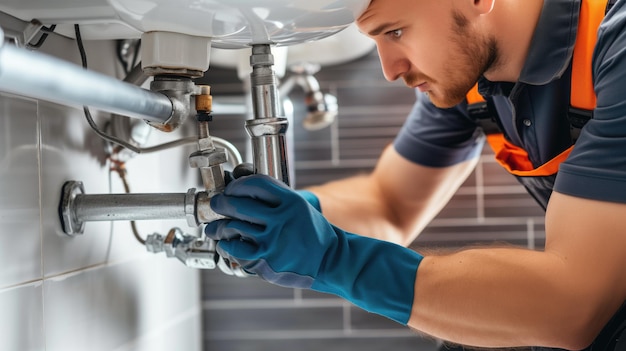
Low water pressure is a persistent complaint in London flats, particularly in Victorian conversions and high-rise blocks where ageing infrastructure and pipe scaling restrict flow. The causes range from mains supply limitations and faulty pressure reducing valves to internal blockages that a qualified plumber can diagnose and resolve. Understanding the specific cause is essential before any remedial work, as the fix for a scaled pipework system differs entirely from one caused by a misadjusted PRV.
Low water pressure is one of the most common complaints from London flat owners and tenants. It manifests as a weak shower, slow-filling baths, or taps that barely run when a neighbour uses water simultaneously. While the symptom is straightforward, the underlying cause often is not — and diagnosing it correctly before spending money on remediation is essential.
Why London Flats Are Particularly Vulnerable
London's housing stock is dominated by Victorian and Edwardian conversions, purpose-built 1960s and 1970s blocks, and more recent high-rise developments. Each of these building types presents distinct pressure challenges.
- Victorian and Edwardian conversions: Many retain original lead or cast-iron supply pipes that have accumulated decades of limescale — London's water is among the hardest in England, drawn from chalk aquifers in the Thames Valley. A 15mm supply pipe reduced internally to an effective bore of 8–10mm by scaling will dramatically restrict flow regardless of mains pressure.
- Low-rise purpose-built flats (1950s–1980s): These buildings frequently use a cold-water storage tank in the roof space and a gravity-fed hot-water cylinder. Gravity systems typically deliver 0.1–0.3 bar at the tap — well below the 1 bar that most modern showers require to operate correctly.
- High-rise blocks: Buildings above five or six storeys usually rely on a booster pump to maintain pressure on upper floors. When that pump degrades or is undersized for the number of units, pressure drops significantly at peak demand times — mornings and evenings.
Common Causes and How They Are Identified
A plumber diagnosing low pressure will typically begin with a dynamic pressure test at the stopcock using a flow gauge, and a static pressure test to distinguish between supply-side and internal causes. This single step often narrows the investigation considerably.
Mains supply pressure below Thames Water's guaranteed level. Thames Water is legally required to maintain a minimum dynamic pressure of 1 bar at the boundary of your property. If a gauge reading at the internal stopcock falls below this under normal demand, the issue lies with the supply main or the communication pipe between the main and the property — this is Thames Water's responsibility. Reporting a sustained low-pressure complaint to Thames Water and requesting a recorded pressure test is the correct first step when supply pressure is the suspected cause.
Scaled or corroded internal pipework. Where mains pressure at the stopcock is adequate but pressure at outlets is not, internal pipework restriction is a likely culprit. A plumber can isolate sections of pipework and test pressure drop across them. In severe cases, replacement of the affected runs — typically in 22mm or 28mm copper to replace undersized or scaled 15mm runs — will restore acceptable flow. Chemical descaling is occasionally viable for short sections but rarely resolves widespread scaling in properties more than 30 years old.
A misset or failed pressure reducing valve (PRV). Many London flats, particularly in converted period buildings, have a PRV fitted at the incoming supply to protect internal pipework and fittings from high-pressure surges. PRVs are typically factory-set to around 3 bar but can be adjusted. They also fail over time, either sticking closed and reducing pressure significantly, or failing open and allowing full mains pressure through. A plumber can test the PRV in minutes and either adjust or replace it — PRV replacement is a straightforward job typically completed within an hour.
Partially closed or corroded stopcock. A stopcock that has not been fully opened — or one that has corroded internally — can restrict flow substantially. This is particularly common in older properties where the stopcock may not have been operated in years. A plumber should confirm the stopcock is fully open and, if it is corroded, replace it as a precautionary measure given that stiff stopcocks can fail entirely when operated.
Shared supply pipe serving multiple flats. In converted houses, a single supply pipe sometimes feeds two, three or more flats. Where this pipe is undersized for the number of units drawing from it simultaneously, pressure will drop at peak times. Resolving this requires either upsizing the shared supply pipe — which typically involves negotiation with the freeholder and neighbouring leaseholders — or installing a cold-water accumulator tank with a booster pump to buffer demand within the individual flat.
What Landlords Should Know
Under the Landlord and Tenant Act 1985, landlords are obliged to maintain the structure and exterior of a property, including water supply pipes within the demised premises. Persistent low pressure that renders a property unsuitable for normal habitation is a disrepair issue, not a cosmetic one. Where the cause is internal pipework, the remedial cost falls to the landlord. Where the cause is the shared supply or the communication pipe, liability may rest with the freeholder or Thames Water respectively.
For landlords managing HMO properties in London boroughs, many local authorities — including Newham, Southwark, Hackney and Tower Hamlets — include minimum water pressure standards within their selective and additional licensing conditions. A plumber's pressure test report provides useful documentary evidence when demonstrating compliance to a licensing officer.
When a Booster Pump Is the Right Solution
Where the mains supply is simply insufficient — or where a gravity-fed system cannot be upgraded by pipe replacement alone — a cold-water booster pump or a pressurised unvented cylinder (to replace a gravity-fed hot water system) will reliably resolve the problem. Unvented cylinder installation must be carried out by a plumber qualified to Part G of the Building Regulations. Work should be notified to Building Control either through a registered competent person scheme or directly with the local authority.
If you are experiencing low pressure in a London flat, a systematic diagnosis is always more cost-effective than replacing components speculatively. A qualified plumber with the right test equipment can typically identify the cause within the first visit and provide a clear, costed recommendation for remediation.
Frequently asked questions
What is the minimum water pressure Thames Water must supply to my London flat?
Thames Water is legally required to maintain a dynamic pressure of at least 1 bar (10 metres head) at your property boundary under the Water Industry Act 1991. If recorded pressure falls consistently below this level, you can raise a formal complaint with Thames Water and request an independent pressure test.
Can I install a booster pump in a London flat to increase water pressure?
Yes, but with important restrictions. You must not connect a pump directly to the incoming mains supply without Thames Water's written consent, as this can deprive neighbouring properties of pressure. The standard compliant approach is to pump from a break tank or cold-water accumulator vessel, or to install a pressurised unvented system — both of which must be installed by a suitably qualified plumber.
How does limescale affect water pressure in London properties?
London's water is very hard, with calcium carbonate deposits building up inside pipework over time and progressively narrowing the internal bore. A 15mm copper pipe with significant scaling can behave hydraulically like a 10mm pipe, roughly halving flow rates. The only reliable remedy for heavily scaled pipes is replacement, as mechanical or chemical descaling rarely restores adequate bore in older installations.
Is low water pressure in a rented flat the landlord's responsibility to fix?
Where the cause is internal pipework within the let premises, yes — the landlord is responsible under the Landlord and Tenant Act 1985 for maintaining water supply installations. If the cause is the shared supply pipe serving the building, liability typically falls to the freeholder. If the mains supply from Thames Water is deficient, the tenant or landlord should report the issue directly to Thames Water.