Is London Tap Water Safe to Drink? What Is In It and Your Filtration Options
London tap water meets all legal drinking water standards and is safe to drink straight from the tap. However, many London residents notice its hardness, taste, and appearance. This guide explains what is in London tap water, why it tastes the way it does, and what filtration options are available for homeowners who want to improve it.
The Safety and Quality of London Tap Water
London tap water is supplied primarily by Thames Water, with smaller portions of the capital served by Affinity Water and SES Water. All three suppliers are regulated by the Drinking Water Inspectorate, which sets and enforces the legal standards for drinking water quality in England. These standards, derived from European and World Health Organisation guidelines, specify maximum acceptable concentrations for over fifty chemical and microbiological parameters including bacteria, nitrates, pesticides, lead, and disinfection byproducts. Thames Water publishes annual reports showing that London tap water consistently meets or exceeds these standards at the point of supply.
The water supplied to London homes originates from two principal sources. Approximately two thirds comes from surface water, primarily the River Thames and River Lee, which is treated at large water treatment works before entering the distribution network. The remaining third comes from groundwater sources, primarily chalk aquifers beneath and around the London Basin. Surface water is treated through a multi-stage process including screening, coagulation and flocculation, sedimentation, filtration, and final disinfection with chlorine or chloramine. The treatment process removes pathogens, suspended particles, and most chemical contaminants to concentrations well within the legal limits.
Why London Water Tastes Different and What Hardness Means
The most commonly noted characteristic of London tap water is its hardness. Water hardness refers to the concentration of dissolved calcium and magnesium ions, which water picks up as it passes through or over chalk and limestone geology. London water is classified as very hard, with a typical hardness of around three hundred to four hundred milligrams per litre expressed as calcium carbonate. This hardness level is entirely safe and in fact calcium in drinking water contributes a small amount to daily calcium intake. However, hard water has several practical effects that many London residents find undesirable.
Hard water causes limescale to form on kettle elements, shower heads, taps, and inside boilers and pipework wherever water is heated. Limescale is calcium carbonate deposited when the dissolved calcium comes out of solution as water temperature rises. In London homes with combination boilers, persistent limescale buildup inside the heat exchanger is one of the most common causes of reduced efficiency and eventual breakdown. Hard water also reacts differently with soap and detergent, requiring more product to achieve the same lather, and leaves marks on glass shower screens and taps when it evaporates. The chlorine added during treatment, while at concentrations well below safety limits, contributes a faint taste and odour that some residents notice particularly when the water is first drawn.
Filtration Options for London Homeowners
Several filtration approaches are available for London homeowners who want to improve the taste, appearance, or hardness of their tap water. A jug filter using activated carbon is the simplest option, removing chlorine and some organic compounds to improve taste without any installation requirement. However, jug filters do not remove hardness minerals and require frequent cartridge replacement to remain effective. A whole-house water softener, installed on the incoming cold water supply, replaces the calcium and magnesium ions responsible for hardness with sodium ions through an ion exchange process. Softened water eliminates limescale formation throughout the property, extends the life of the boiler and appliances, and improves lathering of soap. The installation requires a plumber to connect the softener to the incoming mains supply and a drain connection for the regeneration cycle. Softened water is not recommended for drinking or cooking because of its elevated sodium content, so a separate unsoftened drinking water spur is normally retained at the kitchen sink.
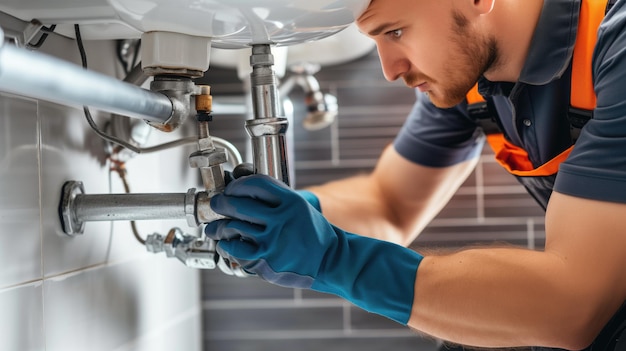
An under-sink reverse osmosis system is the most thorough filtration option for drinking water, removing dissolved minerals including hardness, nitrates, chlorine, and most trace contaminants to produce water with very low dissolved solids. Reverse osmosis systems require connection to the cold water supply and a drain connection for the reject water stream. They produce water slowly, typically storing it in a small pressure tank under the sink, and are supplied through a dedicated drinking water tap mounted at the kitchen sink. Prestige Engineers install water softeners and under-sink filtration systems throughout London, providing a full plumbing service from initial assessment of the incoming water supply through to system commissioning and aftercare.