A practical guide to diagnosing and fixing low water pressure in London flats -- covering mains supply issues, combi boiler pressure, limescale blockages, shower pressure problems, and when a pump is and is not the solution.
Low Water Pressure in London Flats: Where to Start
Low water pressure is one of the most common complaints from residents of London flats, particularly those in upper-floor positions in older buildings. The causes range from a building-wide issue with the mains supply to a blocked aerator on a single tap, and identifying the correct cause before attempting a fix is essential -- fitting a pump, for example, on a system where the underlying issue is a corroded isolation valve, will not resolve the problem and may create new ones.
Understanding London Water Pressure
Thames Water and the other London water companies are required to maintain a minimum dynamic pressure of 1 bar at the property boundary. In practice, pressure at the boundary varies considerably across London -- areas with older cast iron mains, properties at the end of long supply runs, and areas of high demand (particularly during peak morning and evening usage periods) may fall below the target. Upper-floor flats compound this because every floor of vertical height reduces the pressure by approximately 0.1 bar per metre. A flat on the tenth floor of a building with only 1 bar at the boundary may have almost no pressure at the tap.
Diagnosing the Cause
The first diagnostic step is to determine whether the low pressure is confined to one outlet, one temperature (hot or cold), one room, or the entire flat. If all cold outlets in the flat are equally affected, the issue is likely with the mains supply to the flat. If only hot water outlets are weak, the issue may be with the boiler or hot water system. If only one tap is affected, the issue is typically a blocked aerator, a partially closed isolation valve under the sink or behind the tap, or a faulty cartridge in the tap body.
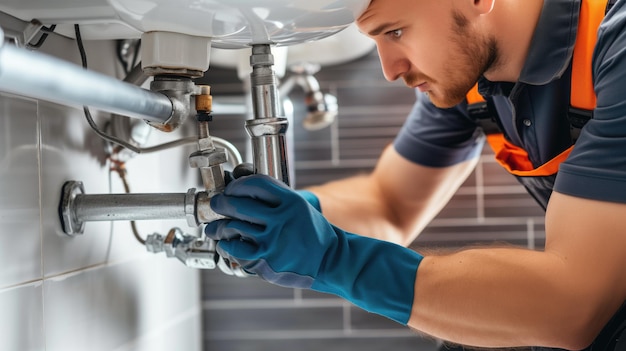
Check the isolation valves under sinks and behind WCs. These quarter-turn valves are sometimes partially closed after maintenance work and not fully reopened. A valve that is turned 45 degrees from the fully open position reduces flow significantly. Ensure all isolation valves are fully open (the slot in the screw head parallel to the pipe).
Combi Boiler System Pressure
For flats with combi boilers, the sealed system pressure (shown on the pressure gauge on the boiler) must be maintained between 1 and 1.5 bar when the system is cold. If the system pressure drops below 1 bar, the boiler may lose efficiency or shut down on a low pressure fault code. Top up the system pressure using the filling loop -- typically a braided flexible hose with two isolation valves located beneath the boiler. Open both valves slowly, watch the gauge rise to 1.2 to 1.5 bar, then close both valves and remove the filling loop if it is a temporary connection. Do not overpressure above 2 bar. If the system pressure drops repeatedly, there is a leak in the system that must be identified and repaired.
Limescale Blockages
In London hard water areas, limescale builds up inside tap aerators, shower heads, and flexible shower hoses over time, progressively reducing flow. Removing and soaking the aerator in descaling solution or white vinegar overnight restores full flow in most cases. Shower heads can be treated in the same way -- detach, submerge in descaling solution, and reinstall. If the shower head or flexible hose is heavily scaled, replacement is often faster and cheaper than descaling. This is a particularly common cause of reduced shower pressure in London properties that have not been recently refurbished.
Shower Pressure: When a Pump Is the Answer
If cold water pressure throughout the flat is confirmed as adequate (above 0.5 bar dynamic) but shower performance is still poor, the issue may be specific to the shower valve or head. For mixer showers on gravity-fed systems (with a cold water tank and hot water cylinder), an inline shower pump or a twin-impeller pump fitted on the hot and cold supply to the shower can boost pressure effectively. This is not appropriate for combi boiler systems -- adding a pump to a sealed combi system will not improve pressure and may damage the boiler. For combi boiler flats with poor shower pressure, the practical solution is an electric shower or a high-pressure electric shower unit rated above 9.5 kW.
Building-Wide Issues
In blocks of flats, low pressure may be a building-wide problem rather than specific to one flat. The building may have a booster pump that is failing, or the mains supply pipe entering the building may be undersized for the current number of occupants. If multiple flats in the same building report the same issue simultaneously, the problem is almost certainly in the common supply infrastructure. This is the responsibility of the freeholder or management company to investigate and rectify -- contact the building management rather than attempting individual flat-level solutions.
When to Call a Plumber
A plumber is needed to investigate further when: isolation valves are fully open, aerators are clean, and pressure is still inadequate; the boiler system pressure is dropping repeatedly; there is a suspected leak somewhere in the system; or the building-wide pressure issue requires investigation of the common supply and booster pump. Prestige Engineers carries out pressure testing and system diagnosis across London and can identify the correct cause before recommending a solution.