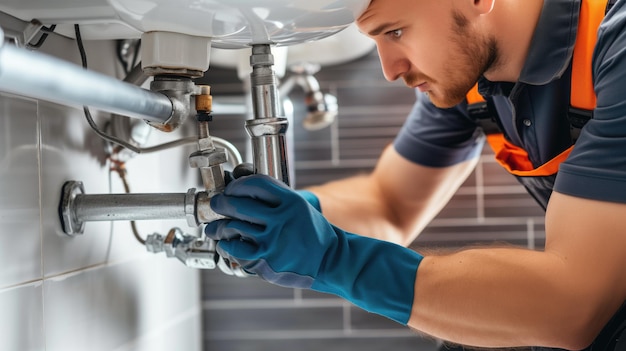
Every commercial kitchen in London that discharges cooking waste to the public sewer is required by Thames Water to fit a grease trap or grease recovery unit to prevent fats, oils, and grease from entering the drainage system. Failure to comply with this requirement can result in enforcement action, fines, and liability for the cost of clearing blockages in the public sewer. This guide explains how grease traps work, what size is required, and how to maintain them.
Why Grease Traps Are Required in London
Fats, oils, and grease (FOG) from commercial kitchen operations are the leading cause of sewer blockages in London. When hot cooking water containing dissolved fats is discharged to the drain, the fats solidify as they cool and adhere to the internal surface of drain pipes and sewer walls. Over time this accumulation, known as fatberg material, can completely obstruct the sewer, causing sewage flooding that may affect multiple properties and requiring expensive emergency clearance by Thames Water.
Thames Water enforces Trade Effluent Consent conditions on commercial kitchen operators discharging to the public sewer. These conditions typically require the installation of an approved grease management device and the maintenance of records demonstrating that the device is being serviced at appropriate intervals. Failure to comply with Trade Effluent Consent conditions is an offence under the Water Industry Act 1991 and can result in enforcement action, the revocation of consent to discharge, and potential liability for the cost of sewer remediation work caused by the discharge.
How a Passive Grease Trap Works
A passive grease trap, also called a hydromechanical grease interceptor, is a plumbing device installed in the drain line between the kitchen sinks and dishwashers and the building drainage system. The device works on the principle that grease is less dense than water and will therefore float to the surface when the wastewater is slowed sufficiently. The trap consists of a chamber divided into compartments by baffles: hot greasy wastewater enters the inlet chamber and slows down as it passes through the baffles, allowing grease to separate and rise to the surface where it accumulates in a grease layer, while the cleaner water below passes out through the outlet to the drain.
Passive grease traps are effective for kitchens with moderate volumes of cooking wastewater and relatively low proportions of emulsified grease. The accumulated grease must be physically removed from the trap at regular intervals, typically weekly for a high-volume restaurant kitchen, to prevent the trap from overflowing grease into the drain. Removal is carried out by skimming the grease layer from the trap surface and disposing of it as a food waste by-product through a licensed waste contractor.
Grease Recovery Units for High-Volume London Kitchens
A grease recovery unit (GRU) is an automated mechanical version of the passive grease trap, designed for kitchens with high volumes of greasy wastewater where a passive trap would require excessively frequent manual emptying. A GRU incorporates a heating element that keeps the trap contents warm to prevent grease solidification, a skimmer mechanism that automatically removes the floating grease layer at timed intervals, and a separate collection container for the recovered grease. The GRU only needs to be serviced when the grease collection container is full, which for a typical London restaurant or hotel kitchen may be once or twice per week.
GRUs are more expensive to purchase and install than passive traps, typically costing between three thousand and ten thousand pounds installed depending on the size and specification, but the reduced labour cost for servicing and the greater reliability of automated grease removal make them the preferred choice for high-volume commercial kitchens. For new restaurant fit-outs in London, GRUs are increasingly specified as standard in the drainage design to avoid the compliance difficulties that can arise with under-specified passive traps.
Sizing a Grease Trap for a London Commercial Kitchen
The size of grease trap required for a London commercial kitchen is determined by the flow rate of wastewater from the kitchen drainage fixtures. The relevant British and European standard for sizing hydromechanical grease separators is EN 1825, which defines a calculation method based on the number and flow rates of the connected fixtures, the temperature of the wastewater, and any chemicals or additives in the wastewater that affect grease separation efficiency. The calculation produces a grease separator size in litres per second of nominal flow rate, and the separator selected must meet or exceed this rating.
A common error made by commercial kitchen operators in London is to undersize the grease trap to reduce the initial installation cost, and then find that the undersized trap overflows grease into the drain system during peak service periods. An undersized trap may also fail to comply with Thames Water Trade Effluent Consent conditions, creating regulatory risk. Prestige Engineers carry out grease trap sizing calculations in accordance with EN 1825 and can advise on the most appropriate type and size of grease management device for each specific kitchen operation.
Maintenance Requirements and Records
Thames Water Trade Effluent Consent conditions typically require commercial kitchen operators to maintain a written log of grease trap maintenance activities, including the date of each service, the volume of grease removed, the identity of the contractor who carried out the service, and confirmation that the grease was disposed of through a licensed waste carrier. These records must be retained for at least two years and must be produced to Thames Water inspectors on request.
Prestige Engineers provide grease trap installation, commissioning, and planned maintenance contracts for London commercial kitchens. Our maintenance service includes a written service report for each visit that meets Thames Water Trade Effluent Consent record-keeping requirements. We can also carry out a compliance audit of an existing grease management installation to assess whether it meets current Thames Water requirements and advise on any remedial work required to achieve compliance.