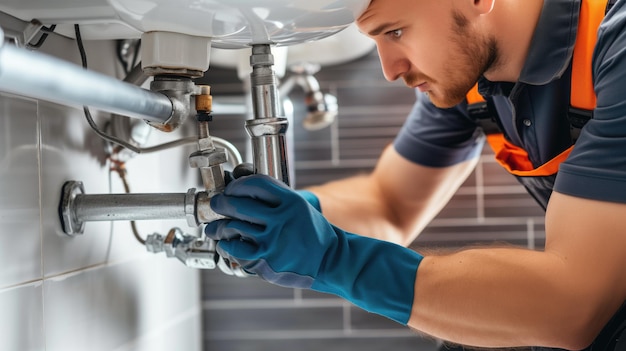
Kitchen plumbing faults generate more emergency call-outs than any other room. Blocked sinks, leaking waste pipes, and dishwasher connection problems are all common in London homes. This guide covers every kitchen plumbing fault with fixes.
Blocked Kitchen Sink — DIY Before Calling a Plumber
Blocked kitchen sinks are overwhelmingly caused by fat, grease, and food debris accumulating in the P-trap or in the first metre of waste pipe. London's hard water accelerates this by causing fat to adhere more firmly to pipe walls.
DIY steps before calling a plumber:
- Remove and clean the P-trap (the U-bend under the sink) — this is where most blockages sit. Place a bowl underneath, unscrew both ends of the trap (hand tight, no tools usually needed), clear the blockage, and reassemble
- Try a plunger with the overflow blocked (seal the overflow with a cloth) — creates back-pressure that can shift soft blockages further into the pipe
- Pour boiling water slowly into the drain — effective for fat-based blockages
- Try a drain unblocker solution if the above steps partially improve flow
When to call a plumber: If clearing the trap and plunging does not improve flow, the blockage is further down the waste run. A drain snake (electric drain auger) can clear blockages up to 10-15 metres into the pipe — plumbers carry these as standard.
Leaking Under the Kitchen Sink
The most common sources of under-sink leaks:
- P-trap joints: The push-fit connections on modern plastic P-traps fail when the rubber washers dry out or are overtightened. Replace the washer (£1) or the trap section (£5-10).
- Waste pipe connection at the wall: Where the kitchen waste pipe enters the wall, the push-fit rubber coupling can fail. These are simple to replace.
- Hot tap supply connection: Flexible braided hoses from the isolation valve to the tap mixer body fail after 8-10 years — typically at the end fittings. Replacement hoses: £8-15 from any plumber's merchant.
- Mixer tap cartridge failure: If the leak is from under the tap handles rather than from the supply connections, the cartridge inside the tap has failed. Cartridge replacement: £15-40 for the part, 30-60 minutes labour.
Dishwasher Connection Problems
Dishwasher installation in London properties frequently reveals:
- No accessible hot water supply: Old London kitchens may not have a hot supply under the sink for the dishwasher's hot-fill connection. Modern dishwashers are cold-fill only — they heat their own water — so this is rarely a problem now.
- Waste connection to sink overflow outlet: The dishwasher waste hose must create a "high loop" or connect via an air gap before entering the sink waste — to prevent backflow of dirty water into the dishwasher. Simply attaching the waste hose directly to the drain without a high loop can cause waste water to drain back into the machine.
- Existing waste outlet blocked by debris: If the previous occupant used the waste outlet for a different purpose and it has debris, the dishwasher waste will overflow or flow slowly.
Frequently asked questions
How do I unblock a kitchen sink drain in London?
Start by removing and clearing the P-trap under the sink (unscrew by hand, clear the blockage, reassemble). If this does not resolve it, try boiling water followed by a plunger with the overflow sealed. If flow is still poor, the blockage is further into the waste run — a drain auger or plumber is needed.
Why does my kitchen sink drain smell bad in London?
A bad smell from the kitchen drain in London is almost always fat and food debris decomposing inside the P-trap or waste pipe — accelerated by London hard water causing debris to adhere to the pipe walls. Clean the P-trap monthly by removing and rinsing it. A biological drain cleaner monthly prevents buildup. Avoid pouring fat, cooking oil, or coffee grounds down the kitchen drain.
Why is my kitchen tap water pressure low in London?
Low kitchen cold tap pressure specifically (when other cold taps are fine) usually means a partially closed isolation valve under the sink, or a scale-blocked aerator on the tap outlet. Unscrew the tap aerator (the small screen at the end of the tap spout), soak in white vinegar for 30 minutes to dissolve scale, and refit. This is the most common cause of gradually reducing kitchen tap pressure in hard water London postcodes.
My dishwasher waste is coming back into the sink — why?
The dishwasher waste hose is not creating a high loop before entering the sink waste — when the pump discharges, water fills the shared waste pipe and backs up into the sink. Create a high loop by routing the waste hose up as high as possible under the sink (attach to the underside of the worktop) before connecting to the drain. Alternatively, fit a dedicated waste trap with a spigot for the dishwasher connection.