A gas leak is a life-threatening emergency. Knowing exactly what to do — and what not to do — in the first minutes can save lives. This guide covers immediate actions, who to call, how engineers make the area safe, and what happens after the emergency.
If You Smell Gas: Immediate Actions
If you smell gas in your home, treat it as a life-threatening emergency. Gas is highly flammable — even a small spark can ignite an explosive concentration. Your actions in the first two minutes matter enormously.
Do these immediately:
- Turn off the gas at the emergency control valve — this is the lever on the incoming gas supply pipe, typically in the meter cupboard or under the stairs. Turn it a quarter turn so it sits perpendicular to the pipe.
- Open all windows and doors to ventilate the property.
- Leave the building immediately, taking everyone with you — including pets.
- Do not re-enter until the National Gas Emergency Service has attended and declared the property safe.
Do NOT do any of the following:
- Do not switch any electrical switches on or off — including lights, appliances, or the extractor fan. A switch creates a spark.
- Do not use any open flames — no matches, no lighters, no candles.
- Do not use your mobile phone inside the building — use it once you are outside and away from the property.
- Do not ring doorbells or use the intercom.
- Do not smoke.
- Do not turn anything electrical on or off — even unplugging a phone charger creates a spark at the socket.
Who to Call
Once you are outside and clear of the building, call the National Gas Emergency Service on 0800 111 999. This is a free 24-hour service operated by Cadent Gas (for most of England). They will dispatch an emergency engineer to your property, typically within an hour.
Do not call a private plumber or gas engineer first — the National Gas Emergency Service is the correct first call. They secure the supply, confirm safety, and can identify the source of the leak. Only once they have made the supply safe should a Gas Safe registered engineer carry out the repair work.
How Gas Engineers Make the Area Safe
When the National Gas Emergency Service engineer arrives, they will:
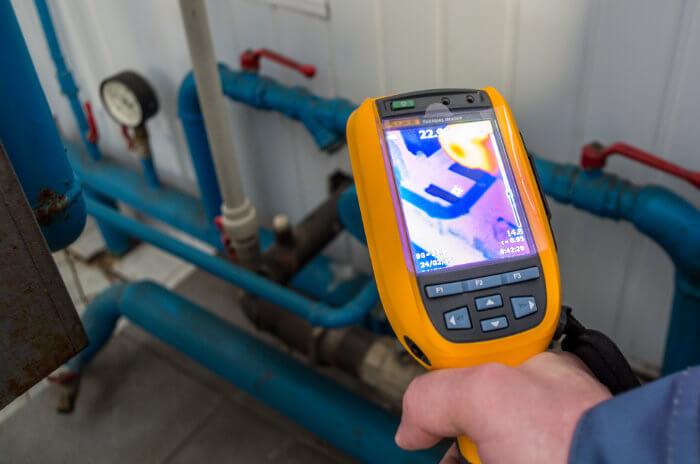
- Use a gas detector to identify the concentration of gas in the property and locate the approximate source.
- Isolate the gas supply at the meter if not already done.
- Ventilate the property thoroughly before entering.
- Confirm the gas concentration has fallen to a safe level before allowing re-entry.
- Identify whether the leak is on the supply pipe (their responsibility) or on the internal installation (your responsibility to repair).
- If the leak is on internal pipework or an appliance, they will cap off or disconnect the defective component — leaving the supply isolated until a Gas Safe engineer repairs it.
Common Causes of Domestic Gas Leaks
Gas leaks in London homes typically arise from one of four sources:
- Faulty appliances: A boiler, cooker, or gas fire that has not been serviced regularly, has a cracked heat exchanger, or has a failed seal on the gas valve. Older appliances are significantly higher risk.
- Corroded pipework: Steel gas pipes in older London properties (pre-1980) can corrode at joints or where they pass through walls. This is less common than appliance faults but causes slow background leaks that are harder to detect.
- Loose fittings: DIY work or work by non-Gas Safe registered engineers can result in poorly made joints that leak over time. Gas fittings must only be made by Gas Safe registered engineers.
- Damaged flexible connectors: The flexible pipe connecting a gas cooker to the wall outlet has a limited lifespan (typically 10 years). An old or kinked flexible connector can develop hairline cracks.
Smell of Gas vs Carbon Monoxide: Different Dangers
These are two distinct hazards that are often confused:
- Natural gas: Has a distinctive sulphur or rotten egg smell added deliberately by gas suppliers (the gas itself is odourless). The danger is explosion and fire from ignition of a gas-air mixture.
- Carbon monoxide (CO): Completely odourless and colourless. You cannot smell it. CO is produced by incomplete combustion in a faulty gas appliance. The danger is poisoning — CO binds to haemoglobin and prevents oxygen transport.
These require different responses. If you smell gas, evacuate immediately. If your CO alarm sounds, also evacuate and call the National Gas Emergency number — but the response is about protecting people from poisoning, not explosion.
Carbon Monoxide Poisoning Symptoms
CO poisoning is often called the silent killer because symptoms mimic illness and victims do not smell anything unusual. Symptoms include:
- Headache (often the first symptom, particularly after waking)
- Dizziness and confusion
- Nausea
- Shortness of breath
- Symptoms that improve when away from home and return when back inside
- Multiple household members or pets showing similar symptoms simultaneously
If you suspect CO poisoning, get everyone into fresh air immediately and call 999. Do not re-enter the property.
Carbon Monoxide Alarms
Every home with a gas appliance should have at least one CO alarm on each floor, positioned at head height and within 1–3 metres of gas appliances. The Smoke and Carbon Monoxide Alarm (Amendment) Regulations 2022 require landlords to fit CO alarms in any room containing a gas appliance. For homeowners, installation is strongly recommended. CO alarms cost £15–£40 and should be replaced every 5–7 years.
After the Emergency: Re-Entry and Follow-Up
Once the National Gas Emergency Service has made the property safe and you are allowed to re-enter, arrange an inspection by a Gas Safe registered engineer as soon as possible. The emergency service will have isolated the fault — but until the repair is carried out, the gas supply may remain off. A Gas Safe engineer will repair the pipework or appliance, pressure-test the installation, and restore the supply.
Any appliance that was involved in or suspected as the source of the leak should be inspected and, if necessary, replaced before being used again. Do not simply restore the gas supply and assume the problem is resolved.
Frequently asked questions
What number do I call for a gas leak in London?
Call the National Gas Emergency Service on 0800 111 999 — free, 24 hours a day, 365 days a year. This is the correct first call for any suspected gas leak, regardless of whether you own or rent your property. Make the call from outside the building, away from the property.
Can I smell carbon monoxide from a gas leak?
No — carbon monoxide is completely odourless. You cannot smell it. The smell you associate with a gas leak is from natural gas (which has a sulphur odour additive). Carbon monoxide is produced by incomplete combustion in faulty appliances and can only be detected by a CO alarm. This is why CO alarms are essential in any home with gas appliances.
Why should I not use my phone inside if there is a gas leak?
Mobile phones and other electrical devices can generate a small spark when activated — particularly at the battery or circuit board. In a space where gas has accumulated to a flammable concentration, any ignition source — including an electrical spark — can trigger an explosion. Leave the building before using your phone, and call 0800 111 999 from outside.
How long after a gas leak can I go back into my home?
You should not re-enter until the National Gas Emergency Service engineer confirms it is safe to do so. This typically requires the gas concentration in the property to fall below the lower explosive limit — confirmed by the engineer using a gas detector. They will tell you when it is safe to return. Once the supply is isolated and the property is ventilated, re-entry is usually permitted within 1–2 hours.