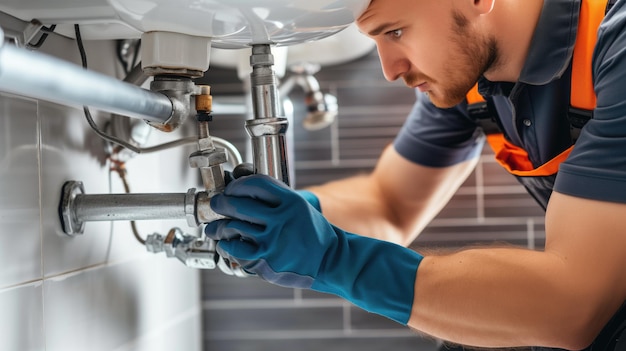
Adding an en-suite bathroom to a bedroom in a London house is one of the most value-adding home improvements available, particularly for three and four bedroom properties where the move from one bathroom to two changes the property category in the market. Understanding the plumbing requirements, the likely costs, and what decisions need to be made early in the project helps London homeowners plan effectively.
Choosing the Location and Size for a New En-Suite
The location of a new en-suite within a London house is the most important design decision and has the greatest impact on cost. The most cost-efficient location is one that can be served by the existing soil stack with minimum pipework extension, where the cold water supply can be taken from an existing circuit on the same floor without a long additional pipe run, and where the drainage can connect to the existing drainage system without requiring the floor to be opened up over a significant area. In a typical London Victorian or Edwardian terrace, the original bathroom is at the rear of the first floor served by a soil stack running on the rear elevation. An en-suite created from space at the rear of the master bedroom on the same floor is therefore in close proximity to the existing drainage and hot and cold supplies, minimising the additional pipework required.
The minimum practical size for an en-suite containing a shower enclosure, WC, and handbasin in a London house is approximately one thousand eight hundred millimetres by one thousand five hundred millimetres, approximately two point seven square metres. At this size, a compact shower enclosure of eight hundred by eight hundred millimetres, a close-coupled WC, and a wall-hung basin can all be accommodated with functional circulation space. A more comfortable en-suite specification, with a larger shower enclosure of nine hundred by nine hundred millimetres or one thousand by eight hundred millimetres, a back-to-wall WC with concealed cistern, and a vanity unit basin, requires a minimum of approximately three point five to four square metres. The space for the new en-suite is typically created by partitioning a portion of the existing bedroom or, in larger London houses, by converting a small storage room or dressing area adjacent to the master bedroom.
The Plumbing Work Required for a New En-Suite
The plumbing work for a new en-suite in a London house covers four main areas: the cold water supply, the hot water supply, the soil and waste drainage, and the ventilation. The cold water supply for an en-suite on the first floor of a house with a combination boiler or unvented hot water cylinder can be taken from the nearest accessible cold water circuit, typically the cold supply to the existing bathroom on the same floor, with a new branch running in the floor void or surface-mounted in boxing to the new en-suite. For a house with a loft-based cold water storage tank feeding the existing bathroom, the cold supply to the new en-suite can similarly be taken as a branch from the existing circuit.
The hot water supply connection depends on the heating and hot water system in the house. For a house with a combination boiler, the hot water is supplied at mains pressure and a new branch can be taken from the existing hot circuit under the floor or in surface boxing. For a house with a stored hot water cylinder, the pressure available at the new en-suite depends on the cylinder position and the height differential. If the pressure is insufficient for the showerhead specification required, a shower pump or a replacement with an unvented cylinder may be part of the project scope. The soil and waste drainage from the new en-suite WC must connect to the soil stack or an underground drain by a route that maintains the minimum fall of one in forty to one in eighty for a one hundred millimetre soil pipe, and the connection point must not create a risk of siphonage to existing appliances. Where the en-suite is remote from the existing soil stack, a Saniflo macerator toilet is sometimes used as an alternative to running new gravity drainage, which avoids the need to open up floors and can significantly reduce installation cost in certain layouts. Prestige Engineers assess, design, and install new en-suite bathrooms in London houses, providing a complete service from initial feasibility and design through to plumbing, drainage, waterproofing, tiling, and sanitaryware fitting.