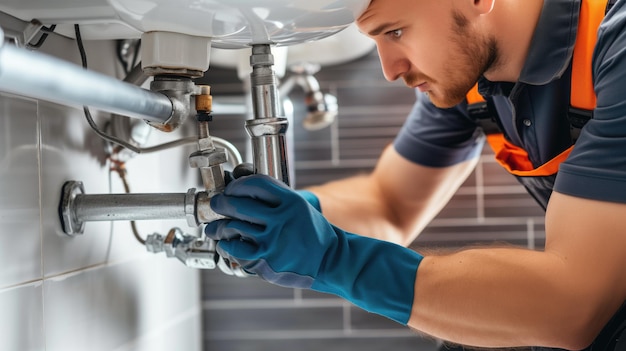
Underfloor heating is an increasingly popular choice for London bathroom and kitchen renovations, extensions, and new builds. There are two distinct types of underfloor heating system, and the type chosen determines which trade or trades are required for the installation. Wet underfloor heating, which circulates warm water through pipes in the floor, is a plumbing job. Electric underfloor heating, which uses electrical heating cables or mats in the floor, is an electrical job. Many London projects involve both trades depending on the system chosen and the scope of the project.
Wet Underfloor Heating: A Plumbing Installation
Wet underfloor heating uses a network of plastic pipes laid within or beneath the floor construction through which warm water circulates from the boiler or heat pump. The pipework is connected to a manifold, which controls the flow of water to each heating zone and allows individual zones to be controlled independently. Because the system uses water circulating through pipework connected to the central heating system, the installation is primarily a plumbing job. The plumber installs the manifold, lays the pipe loops in the floor in the pattern required to achieve even heat distribution, connects the manifold to the flow and return pipework of the central heating system, and pressure-tests the underfloor pipe loops before the floor screed or overlay is applied.
For a wet underfloor heating system connected to a gas boiler, the gas engineer may also be involved if the boiler settings or the heating controls need to be adjusted for the low-temperature flow regime that underfloor heating requires. Underfloor heating systems work most efficiently at flow temperatures between 35 and 55 degrees Celsius, which is lower than the flow temperatures typically used for radiator systems. If the boiler is a modern condensing boiler, it can usually be set to operate at the lower flow temperature, but the setting adjustment should be carried out by a Gas Safe registered engineer. For systems connected to a heat pump, the heat pump installer will commission the system at the appropriate low-temperature flow regime.
Electric Underfloor Heating: An Electrical Installation
Electric underfloor heating uses heating cables or heating mats embedded in the floor, which generate heat by electrical resistance when current flows through them. The heating cable or mat is connected to a thermostat and to the electrical supply, and the installation is purely an electrical job. A Part P qualified electrician must install the circuit cable from the consumer unit, fit the thermostat, connect the heating element, and issue an Electrical Installation Certificate on completion. The circuit must be protected by a residual current device as required by BS 7671, and the installation must be notified to the local authority under the Building Regulations Competent Person Scheme.
Electric underfloor heating is commonly installed in London bathrooms and kitchens as a standalone comfort heating system beneath a tiled floor, where it supplements rather than replaces the central heating system. Because the floor surface above an electric underfloor heating mat must not be too thermally resistant, the tile adhesive and tile specification must be compatible with underfloor heating, and this should be confirmed with the tiler before the system is ordered. The thermostat for an electric underfloor heating system in a bathroom must be located outside the bathroom zones defined by BS 7671, or it must be a splash-proof model suitable for the zone in which it is located, and the electrician will advise on the correct thermostat position when designing the installation.
Choosing the Right System and Trade for a London Project
For a London bathroom renovation where underfloor heating is being added, electric underfloor heating under a tiled floor is the most common choice because it does not require a screed, can be installed quickly in the first fix stage, and does not require connection to the central heating pipework. For a larger London new build, extension, or whole-property renovation where underfloor heating is being used as the primary heating system throughout the ground floor, wet underfloor heating connected to a boiler or heat pump is typically more cost-effective to run over the long term. Prestige Engineers can install wet underfloor heating systems and connect them to existing or new central heating systems across all London boroughs, and can advise on which system is most suitable for your project.