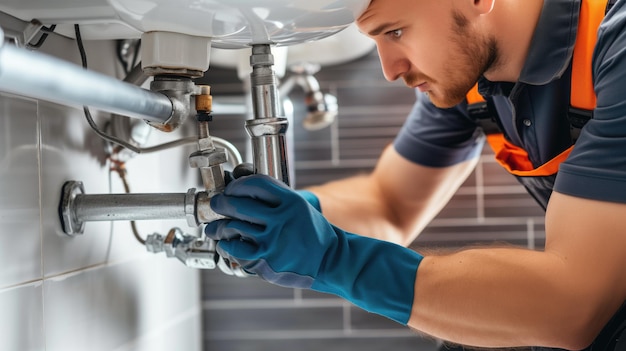
A dripping tap wastes thousands of litres of water per year and raises your water bill. This guide explains what causes taps to drip, what you can realistically fix yourself, and when a professional plumber is the better call.
Why Taps Drip
A dripping tap is caused by a worn or damaged sealing component inside the tap body — the part that closes off the water flow when the handle is in the off position. The specific component depends on the type of tap. In traditional rising-spindle taps (the type with rubber washers, common in older London properties), the rubber washer at the base of the spindle wears and cracks over time, allowing a small amount of water to pass even when the tap is off. In modern quarter-turn ceramic disc taps, a pair of ceramic discs seal against each other. When these discs become scored by grit particles or coated with limescale, they no longer seal completely.
London hard water is a significant accelerator of tap failure. The calcium and magnesium content of London tap water — typically 250 to 400 milligrams per litre — deposits limescale on all internal surfaces that water contacts. On ceramic disc taps, this limescale builds up on the flat sealing faces of the discs and prevents them from seating correctly. On rubber washer taps, limescale abrades the washer surface over time. Most London properties experience faster tap wear than equivalent properties in soft-water areas.
How Much Water a Dripping Tap Wastes
A tap that drips once per second loses approximately 5,500 litres of water per year. At Thames Water metered rates of approximately 0.31 pence per litre (combined water and sewerage charge), this costs approximately £17 per year. A faster drip — say three drips per second — wastes over 16,000 litres per year at a cost approaching £50. A tap that produces a continuous thin trickle rather than individual drips can waste 100 to 200 litres per day — a significant cost on a metered supply.
Beyond the direct water cost, a continuously dripping tap causes ongoing wear to the valve seat inside the tap body. If the drip is left for months or years, the seat becomes scored and worn, to the point where a new washer or cartridge will not produce a complete seal even when freshly fitted. At that stage, the valve seat must be reground with a seat grinder tool, or the tap body must be replaced entirely.
DIY Tap Repair: What Is Realistic
Replacing a rubber washer on a traditional rising-spindle tap is a genuine DIY task. The water supply to the tap is turned off at the isolation valve under the sink or at the stopcock. The tap handle is removed (usually secured by a grub screw under a decorative cover disc). The tap bonnet nut is unscrewed with a spanner. The spindle is withdrawn, exposing the washer at the base held by a small brass nut. The old washer is removed, a new matching washer is fitted, and the tap is reassembled. The entire process takes 15 to 30 minutes and the parts cost less than £1.
Replacing a ceramic disc cartridge on a quarter-turn tap is similarly achievable as DIY. The process is the same — remove the handle, unscrew the cartridge body, pull out the old cartridge, fit the new one. The challenge is identifying the correct replacement cartridge. Cartridges are not universal — the diameter, height, and hot-cold orientation vary between manufacturers and models. Fitting the wrong cartridge results in a tap that does not turn off, or turns off in the wrong direction. Accurate identification of the tap brand and model, or taking the old cartridge to a plumbing merchant for matching, is essential before purchasing a replacement.
When to Call a Plumber
Call a plumber when the tap seat is visibly scored or damaged, when the drip does not stop after replacing the washer or cartridge, when the tap spindle is corroded and will not move, when the water supply isolation valve under the sink is seized and cannot be turned, or when the tap body itself is physically damaged or leaking at the body joints. Attempting to repair a seized or corroded tap without the correct tools risks snapping the spindle or cracking the tap body, turning a simple repair into a tap replacement. A plumber attending a dripping tap in London typically resolves the fault in 30 to 60 minutes and can replace the tap entirely if the fault cannot be economically repaired. Contact Prestige Engineers for dripping tap repair across all London boroughs.