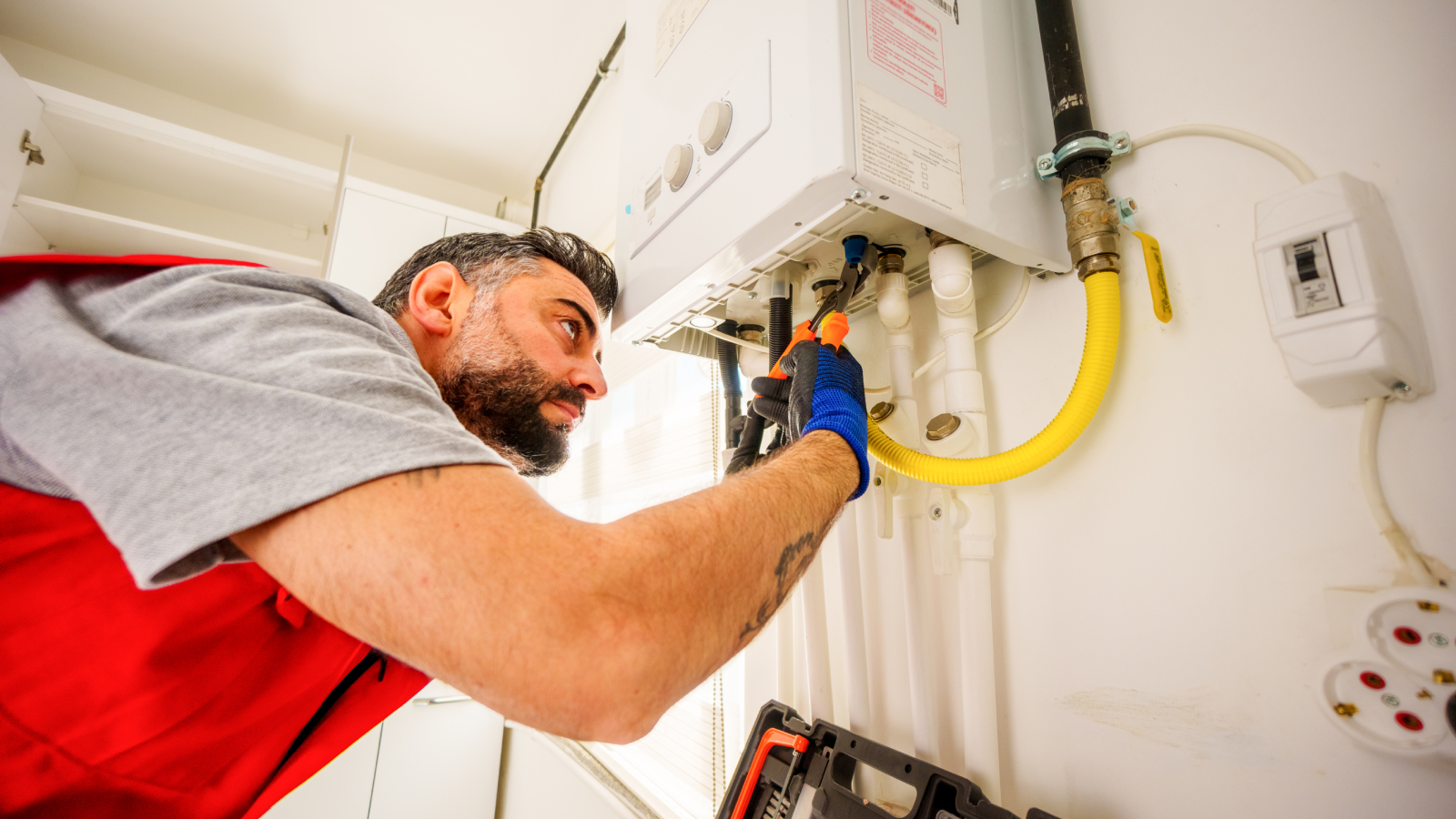
When a boiler fails to turn on, the cause is often straightforward and discoverable without calling an engineer immediately. A systematic approach — working through the most common and easily checked causes before reaching for the phone — will either resolve the problem or give you useful information for the engineer you do end up calling.
Before You Start: What "Not Turning On" Actually Means
There is a useful distinction between a boiler that is genuinely unresponsive — no display, no signs of power, completely inert — and one that is powered and displaying a fault code but not running. The first suggests an electrical supply problem; the second is a boiler fault that has caused a safety lockout. The troubleshooting path differs for each.
Step 1: Check the Power Supply
A boiler with no display at all — completely dark, no lights, no sounds — has no electrical supply. Check:
- The boiler isolator switch: Modern boilers are typically connected via a fused spur or double-pole isolator switch on the wall near the boiler. Confirm this switch is in the ON position. These switches occasionally get turned off by accident, particularly in kitchens where the boiler shares a wall with the kitchen worktop.
- The consumer unit (fuse board): Check whether any MCB (circuit breaker) has tripped. A tripped MCB sits in a slightly different position from the others — it will be between ON and OFF, or clearly in the OFF position, depending on the type of board. Identify the circuit labelled "boiler" or "central heating" and reset it by pushing firmly to the OFF position then back to ON. If it trips again immediately, there is an electrical fault that requires an electrician.
- Is the property's electricity supply working generally? If other appliances on the same ring main are also not working, the issue may be with the main supply rather than the boiler circuit specifically.
Step 2: Check the Gas Supply
If the boiler has power (display is lit, controls are responding) but the boiler is not firing and showing an ignition failure or "no gas" code, check whether the gas supply to the property is functioning:
- Try the gas hob or cooker: Attempt to ignite a gas hob burner. If the hob lights and burns steadily, the gas supply to the property is working and the fault is within the boiler itself, not the supply. If the hob also fails to light, there may be a supply problem.
- Check a prepayment meter: If the property has a pay-as-you-go gas meter, check whether there is remaining credit. Prepayment meters that have run to zero will cut the gas supply until topped up — this is a common and easily overlooked cause of boiler failure in rental properties and some owner-occupied homes.
- Check the gas meter isolation valve: The valve on the gas meter (a flat-head screwdriver slot or lever handle) should be in the ON position — typically parallel to the pipe. If it has been turned off (perpendicular to the pipe), turn it back to ON. Note: if you are unsure whether this valve was off for a reason — a suspected gas leak, for example — do not turn it back on yourself. Call the National Gas Emergency Service on 0800 111 999 instead.
Step 3: Check the Boiler Pressure
Most combination boilers and system boilers have a pressure gauge visible on the front of the boiler — either an analogue dial or a digital display. The correct operating pressure for most domestic boilers is 1.0–1.5 bar.
- Below 0.5 bar: The boiler may refuse to fire at all due to a low-pressure safety lockout. Repressurise the boiler using the filling loop — a small flexible braided hose connecting two valves on the boiler's pipework below the unit. Open both valves slowly until the pressure gauge reaches 1.2–1.5 bar, then close both valves. Reset and test.
- Above 3 bar: Very high pressure is less common as a cause of the boiler not starting but is a fault that requires investigation — typically an expansion vessel problem. Do not attempt to operate the boiler at very high pressure; call an engineer.
Step 4: Check the Thermostat
A boiler receives a demand signal from the room thermostat — without that signal, the boiler will not fire even if it is in perfect working order. Common thermostat issues:
- Thermostat setpoint lower than room temperature: If the thermostat is set to 18°C and the room is already 20°C, the boiler will not fire — it believes the demand has been met. Turn the thermostat setpoint up to 22°C to confirm whether the boiler then starts.
- Wireless thermostat batteries: Many modern thermostats run on batteries. A thermostat with flat batteries will not send a demand signal. Check and replace the batteries if the thermostat display is dim or blank.
- Thermostat switched off or in summer mode: Some thermostats have a physical on/off switch or a summer/winter mode. Confirm the thermostat is in heating mode.
- Smart thermostat app issue: If you use a smart thermostat (Nest, Hive, tado°), confirm the app shows the thermostat as connected and that a heating schedule is active. A disconnected smart thermostat sends no demand and the boiler will not fire.
Step 5: Check the Time Programmer
If the boiler has a time programmer or is controlled by a timer — either on the boiler itself or as a wall-mounted programmer — check that:
- The programmer's clock is showing the correct time (a power cut resets many older programmers to midnight or 00:00)
- The current time falls within a scheduled heating period
- The programmer is not in "off" mode or "holiday" mode
- For zone valve systems, both the programmer and any individual zone switches are set to heating on
An incorrect programmer clock is a common and very simple cause of boilers that "stop working" after a power cut — the programmer resets to an incorrect time and the scheduled heating period no longer corresponds to when heating is actually needed.
Step 6: Note the Fault Code
If the boiler has power but is displaying a fault code on the screen, note the exact code before doing anything else. The fault code is the boiler's diagnostic output — it tells you (and any engineer you call) at which point in the operating cycle the fault occurred. Common codes and what they mean in general terms:
- Ignition failure (Vaillant F.28, Worcester EA): attempted to fire but no flame detected
- Low pressure lockout: pressure below minimum operating threshold
- Overtemperature lockout: boiler reached an excessive temperature (blocked pump, air lock, heat exchanger fault)
- Fan or flue fault: the flue fan is not reaching the required speed before ignition
Look up your specific fault code in the manufacturer's documentation (available on their website or on the instruction leaflet typically kept inside the boiler casing door) before resetting. Understanding what the code means helps you decide whether it is a simple reset situation or one requiring an engineer.
Step 7: Try One Reset
If the boiler has locked out with a fault code and you have completed the checks above, attempt one reset. Press and hold the reset button (typically marked with a flame and a circle arrow, or labelled "Reset") for three to five seconds. The boiler will attempt to restart its ignition sequence.
The one-reset rule is important: If the boiler locks out again on the same code, do not reset it a second time. Repeated resetting without addressing the underlying fault masks the problem, can cause additional damage (forcing ignition attempts without gas causes spark electrode wear; repeated lockouts on overheat faults can damage the heat exchanger), and makes diagnosis harder. One reset, one attempt — if it fails, call an engineer.
Step 8: When to Call a Gas Safe Engineer
Call a Gas Safe registered engineer if:
- The boiler does not start after completing all of the above checks
- The boiler locks out again after a single reset
- You smell gas (call the National Gas Emergency Service on 0800 111 999 first, then a Gas Safe engineer after the emergency service has attended)
- The boiler pressure is very high (above 3 bar) or drops repeatedly
- You hear unusual sounds from the boiler — banging, gurgling, or a high-pitched whine
Urgent vs. Can-Wait
Context matters when deciding how quickly to act:
- Urgent — same day or next morning: Complete loss of heating and hot water during cold weather; boiler fault in a property with elderly occupants, young children, or vulnerable residents.
- Can wait one to two days: Loss of heating only with a functional hot water system; mild weather; access to an electric shower for hot water while the boiler is out.
- Gas emergency — immediate: Any gas smell, suspected gas leak, or carbon monoxide detector alarm. Do not wait — call 0800 111 999 immediately.
Frequently asked questions
Why is my boiler not turning on when the thermostat is calling for heat?
The most common causes are: the boiler has locked out with a fault code (check the display); the boiler pressure is below the minimum threshold (check the pressure gauge — it should read 1.0–1.5 bar); the programmer is not in an active heating period or its clock has reset after a power cut; or there is a gas supply issue (check whether your gas hob lights). Work through these checks systematically before resetting the boiler. If the fault code reappears after a single reset, a Gas Safe engineer is needed to diagnose the underlying cause.
Should I keep resetting my boiler if it keeps locking out?
No — try one reset and observe whether the boiler restarts and runs normally. If it locks out again on the same fault code, do not keep resetting. Repeated resetting without fixing the underlying fault wears out components (particularly the spark electrode during ignition failure lockouts), can cause damage in overheat lockout situations, and makes proper diagnosis harder. One reset tells you whether the fault was a one-off; repeated lockout on the same code tells you there is a persistent fault requiring engineer diagnosis.
What should I do if my boiler has no display at all?
A completely dark boiler with no display has no electrical supply. Check the boiler isolator switch (typically a double-pole switch or fused spur on the wall near the boiler) is in the ON position. Then check your consumer unit for a tripped MCB on the boiler circuit — reset it by pushing firmly to OFF then back to ON. If it trips again immediately, there is an electrical fault requiring an electrician. If the whole property has lost power, contact your electricity supplier. If power is restored but the boiler remains dark, the boiler's internal fuse or PCB may have failed.
How do I repressurise my boiler if the pressure is too low?
Most combination boilers are repressurised using the filling loop — a small braided flexible hose or built-in filling key connection on the pipework below the boiler. With the boiler off, open both filling loop valves slowly (or turn the filling key). Watch the pressure gauge on the boiler rise — stop when it reaches 1.2–1.5 bar and close both valves. If the boiler has a digital display, it may show the pressure numerically. Do not overpressurise — stop at 1.5 bar. After repressurising, reset the boiler. If the pressure drops again within a few days, there is a leak in the system requiring an engineer.