Acoustic leak detection uses specialist correlators and ground microphones to find hidden pipe leaks without excavation. This guide covers how the technology works, what it costs in London, and when you need it.
What Is Acoustic Leak Detection?
Acoustic leak detection is a specialist non-invasive method of locating leaks in pressurised water pipes without any excavation or destructive investigation. The technique relies on the fact that water escaping from a pressurised pipe under pressure creates a characteristic vibration that travels along the pipe wall and through the surrounding ground. Acoustic correlators and ground microphones capture these vibrations and allow the engineer to pinpoint the leak location to within half a metre on a straight pipe run.
The technology was developed for water utility companies to locate leaks in distribution mains without digging up roads and pavements. It is now widely used in London for residential and commercial properties where an underground supply pipe, a concealed internal pipe, or a buried heating circuit is suspected to be leaking but cannot be accessed without significant disruption to the property.
How Acoustic Correlation Works
The acoustic correlation process involves placing two sensors at known points along the pipe — for example, at the stopcock inside the property and at the water meter at the boundary. Each sensor detects the noise signal produced by the escaping water. Because the sensors are at different distances from the leak, the noise arrives at each sensor at slightly different times. The correlator measures this time difference and, combined with the known pipe material and diameter (which determine how fast sound travels through that pipe), calculates the distance from each sensor to the leak point.
Modern digital correlators are accurate to within 0.3 to 0.5 metres on a straight pipe run in ideal conditions. On a long pipe with multiple bends, or on older pipes of uncertain material, the accuracy may be slightly reduced but is still far better than any other non-invasive technique.
Ground microphones complement acoustic correlation for surveys where sensors cannot be placed at two points on the pipe. The engineer sweeps a highly sensitive microphone across the ground surface above the suspected pipe run, listening for the noise maximum that indicates the position of the leak. Ground microphones are particularly effective on shallow pipes and in areas where the soil transmits sound efficiently.
When Acoustic Leak Detection Is Needed in London
The most common indicators that an acoustic leak detection survey is required are as follows. The water meter shows consumption when all taps and appliances in the property are turned off — this is the clearest possible indication of an underground leak between the meter and the property. Damp patches on ground-floor floors or on solid ground-floor walls with no visible plumbing at that location suggest water tracking through the structure from a buried pipe. Boiler pressure repeatedly drops without obvious cause, suggesting a leak in the underfloor heating circuit or a buried hot water pipe. Water bills have increased significantly without any change in household usage. Staining, efflorescence, or soft spots on a driveway or patio surface above a known pipe run.
In London, the supply pipe between the boundary stopcock and the property is typically the homeowner responsibility and is commonly a lead or early copper pipe installed at the time the property was built. Many Victorian and Edwardian London properties have supply pipes that are 80 to 130 years old, and compression joints on these pipes can fail gradually, producing low-level leaks that go undetected for months or years.
Tracer Gas Detection for Difficult Leaks
For leaks that acoustic methods cannot locate — typically plastic pipework under thick concrete or pipes at significant depth — tracer gas detection is used. A mixture of hydrogen and nitrogen (95 percent nitrogen, 5 percent hydrogen) is introduced into the empty pipe after the water is turned off. This non-toxic, non-flammable gas mixture escapes from the leak point and percolates upward through the soil. A sensitive handheld detector is then swept across the ground surface to locate the gas concentration maximum, which corresponds to the leak point below.
Tracer gas is particularly effective for finding leaks in underfloor heating circuits, for locating very small leaks that produce insufficient acoustic noise for correlation, and for confirming the location identified by acoustic methods before any excavation is carried out.
Thermal Imaging as a Complement
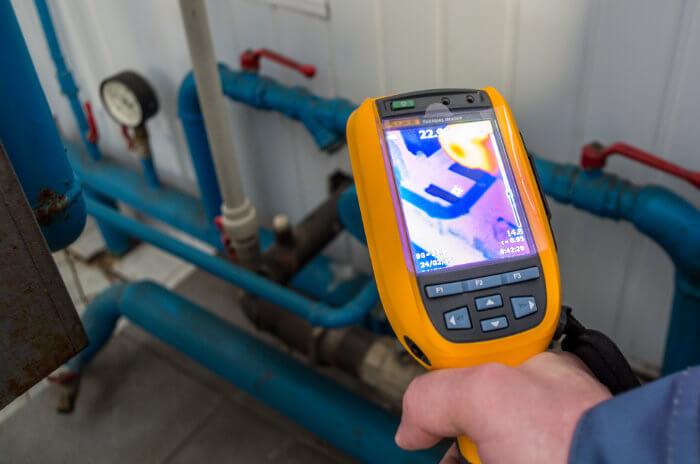
For leaks within buildings rather than underground, thermal imaging cameras provide a rapid way to identify temperature differentials caused by the presence of water. A cold water leak cools the surrounding floor, wall, or ceiling structure. A hot water or heating pipe leak warms it. The camera identifies these thermal anomalies and directs the acoustic survey to the most productive areas, reducing survey time and increasing accuracy.
Acoustic Leak Detection Costs in London
The following cost ranges are current for residential acoustic leak detection surveys in London from Prestige Engineers.
- Acoustic correlation survey only: from £150 to £250 — covers a single pipe run from meter to property, up to 30 metres
- Ground microphone survey: from £150 to £200 — covers a specific suspect area, typically up to one hour of active scanning
- Combined acoustic and ground microphone survey: from £250 to £350 — most thorough approach for supply pipe leaks
- Thermal imaging survey (internal): from £200 to £300 — full internal scan of a 2 to 3 bedroom property
- Combined acoustic, thermal, and tracer gas survey: from £350 to £500 — for complex or difficult-to-find leaks
- Insurance trace report: included with all surveys at no additional charge — written report suitable for submission to building insurer under trace and access clause
Trace and Access Insurance
Most standard buildings insurance policies in London include a trace and access clause that covers the reasonable cost of locating a leak — that is, the cost of the detection survey and any limited investigation required to confirm the location. The clause does not cover the cost of the repair itself. Prestige Engineers provides a detailed written leak location report after every survey, recording the survey method, the equipment used, and the confirmed or probable leak location with a site plan. This report is the document your insurer requires to process a trace and access claim.
Contact Prestige Engineers to arrange an acoustic leak detection survey across any London borough. We aim to attend within 24 to 48 hours of enquiry.